THE CHAIN JOURNAL
Independent Crypto Editorial

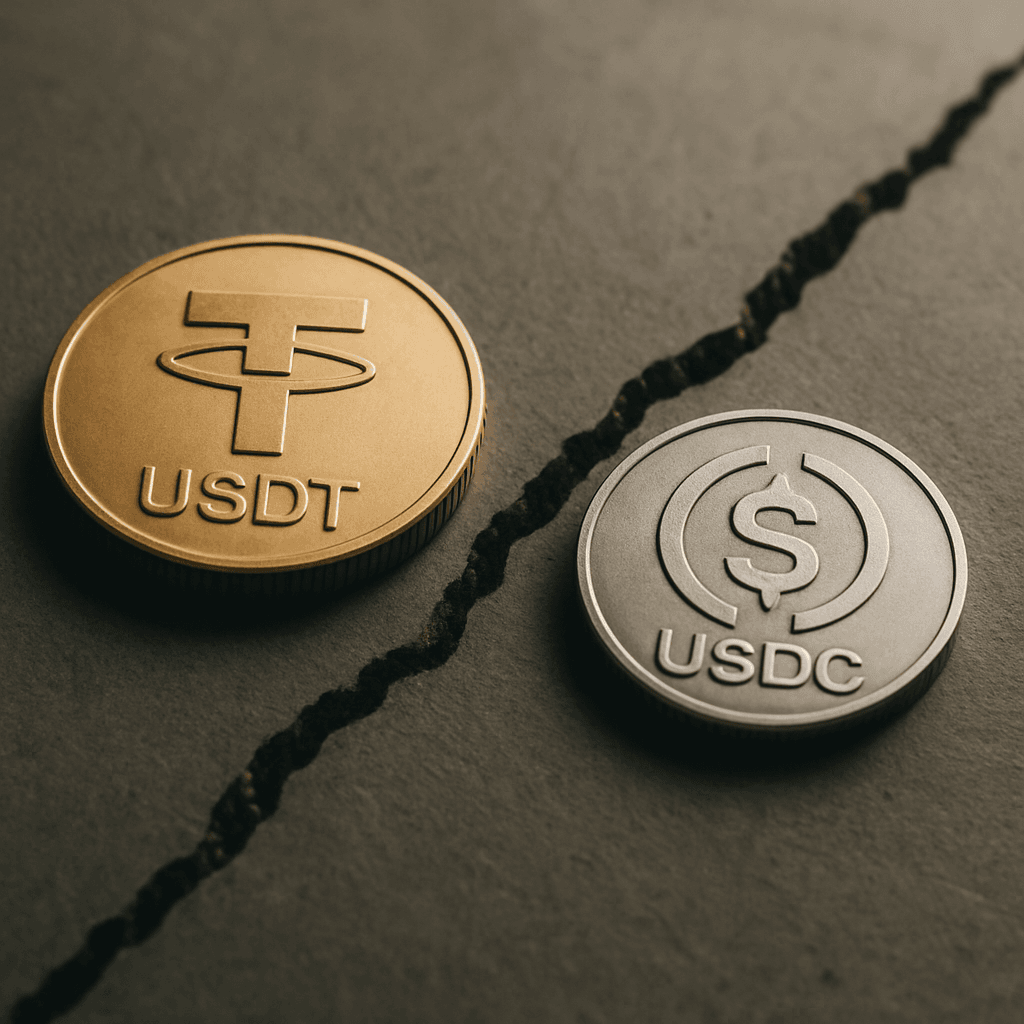
usdt payments usdc defi diverges as stablecoin adoption shifts. New Dune data explains why stablecoin use cases are splitting.
usdt payments usdc defi is not a branding story. It is a distribution story. The latest Dune analysis suggests that Tether’s token has become the default rail for payments-heavy activity, while Circle’s token holds a stronger grip on collateral, lending, and trading venues. That split matters because stablecoins do not compete only on peg quality – they compete on where liquidity already lives. In practice, stablecoin adoption follows the path of least friction, and that path looks different depending on whether you are talking about retail transfers, merchant settlement, or onchain leverage. The market is learning that the same asset can behave like cash in one venue and like working capital in another, shaped entirely by chain, wallet type, and integration depth.
The more telling point is what this reveals about stablecoin use cases. Investors often speak about USDT and USDC as though they were near-identical products. They are not. One is embedded in broad payments flows and exchange circulation; the other is more tightly woven into DeFi’s programmable stack. That difference is not cosmetic – it shapes velocity, fee sensitivity, and where new supply tends to settle. When a stablecoin becomes the path of least resistance for remittances or commerce, it can accumulate enormous volume without ever winning developer mindshare. That is precisely why the usdt payments usdc defi divide deserves more serious attention than a routine market-share headline.
The data points to a market that is growing more specialized, not more unified. Dune’s recent stablecoin research shows that the sector now spans payments, settlement, DeFi liquidity, and institutional workflows, with major issuers competing on far more than brand recognition. In broad terms, USDT remains the more visible payments asset, while USDC tends to surface in environments where composability is the priority. Across the wider on-chain landscape, the stablecoin market has grown large enough that the distinction between a “transfer” and “productive capital” now matters as much as the token itself. That is the lens through which usdt payments usdc defi should be interpreted.
For readers tracking the mechanics, the critical question is not simply which token commands more supply – it is where each token sits within the stack. A payments stablecoin must be cheap, fast, and universally accepted. A DeFi stablecoin must route cleanly through lending markets, liquidity pools, and structured strategies. Those requirements generate very different network effects. As tracked by DeFi protocol metrics, liquidity gravity still clusters around specific chains and protocols rather than any single universal stablecoin. That fragmentation is manageable, but only if users can move capital without paying a steep tax in complexity.
The market keeps treating stablecoins as a single category because it is convenient – but the underlying structure is shifting. Payments activity rewards distribution partnerships, wallet defaults, and low-friction onboarding. DeFi rewards depth, collateral quality, and venue compatibility. Those are different businesses with different winners. That distinction is uncomfortable for traders hunting one clean beta trade, but it is far more useful for investors trying to understand where cash flows actually go. The result is that usdt payments usdc defi looks less like a passing preference and more like a durable division of labor.
A useful analogy is how other financial instruments split by function rather than by issuer. Money-market funds, treasuries, and bank deposits all perform similar dollar jobs, yet they behave differently because users assign them different roles. Stablecoins are moving in the same direction. The next leg of growth may not arrive through one token capturing everything – it may come from each token becoming sharper at a narrower task. That dynamic also carries real implications for chain strategy: the chain that wins payments may not be the chain that wins DeFi, and the reverse is equally true. If that proves out, usdt payments usdc defi will be remembered as a market map, not a slogan. For broader context on how policy could accelerate or constrain these distribution patterns, the stablecoin regulation 2026 outlook is worth following closely.
usdt payments usdc defi tells investors to stop asking which stablecoin is “better” and start asking which workflow each one powers. USDT appears better positioned where speed, ubiquity, and transactional utility are what counts. USDC looks more naturally aligned with DeFi collateral, onchain lending, and structured capital deployment. That does not make one token superior in any absolute sense – it means each solves a different problem, and the market is finally beginning to price that distinction properly. For portfolio construction, the implication is straightforward: stablecoin exposure is no longer a simple proxy for dollar liquidity. It is a bet on network placement.
What to watch next is more practical than theoretical. Keep an eye on whether payment-focused chains continue expanding merchant and wallet integrations, whether DeFi activity keeps consolidating around a handful of deep liquidity venues, and whether issuers accelerate their push into verticalized products. If the divide keeps widening, usdt payments usdc defi becomes an operating model for the entire sector – not a temporary anomaly, but the new default architecture.
Focus: usdt payments usdc defi is the clearest signal yet that stablecoins are specializing by function, not converging by brand.
Lena Strauss, Regulation & Policy Reporter, The Chain Journal
A weekly briefing on Bitcoin price action, Ethereum, crypto market analysis, Bitcoin ETF flows, regulation, digital assets, and the narratives shaping crypto investing.
One sharp weekly read. No daily alerts. No recycled headlines.




