THE CHAIN JOURNAL
Independent Crypto Editorial

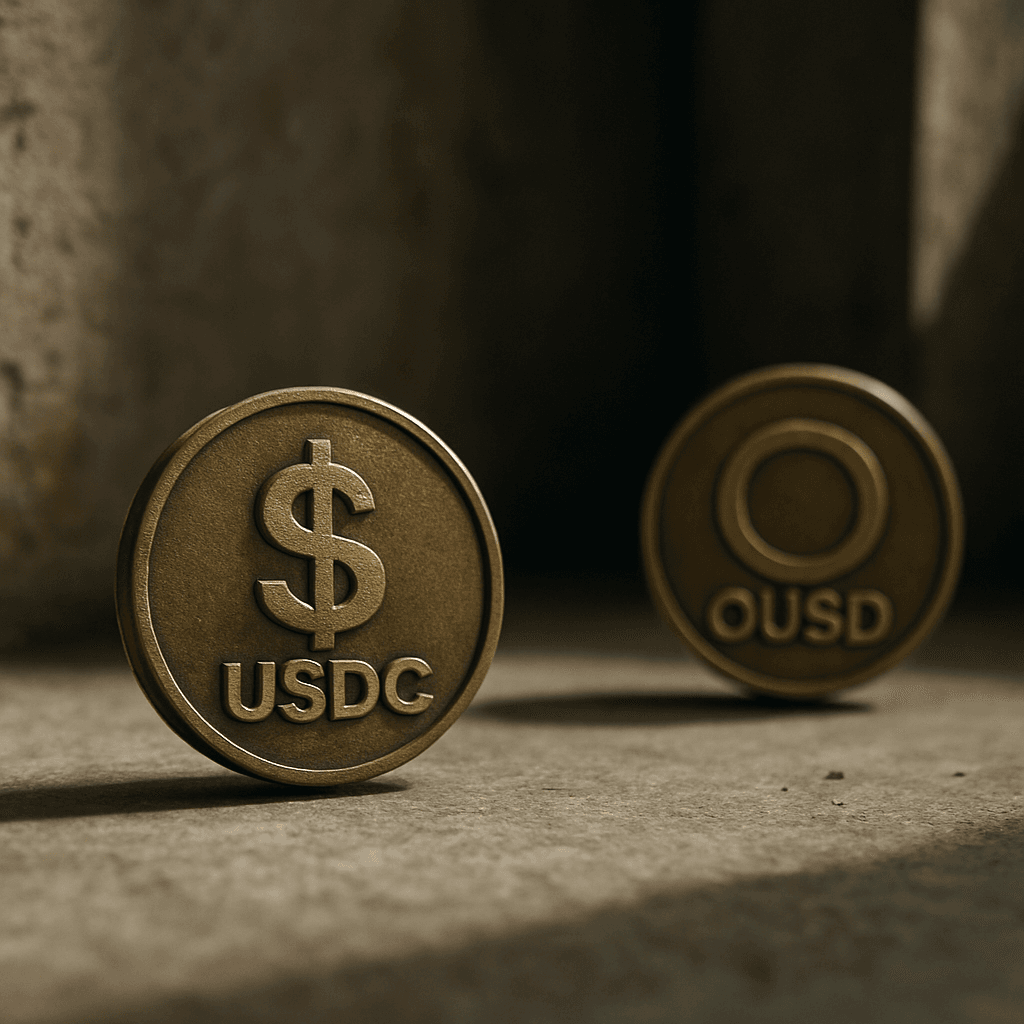
Stablecoin duopoly faces a new test as OUSD stablecoin gains attention and Circle network advantage remains the core moat.
The stablecoin duopoly has long rested on a simple market truth: liquidity attracts liquidity, and trust compounds slowly. That is why USDC still commands a circle network advantage even as new entrants scramble for room. Circle’s own materials show a broad distribution footprint, and recent market commentary underscores USDC’s growing role in settlement and payments – not just trading. Against that backdrop, the arrival of OUSD stablecoin adds a new dimension to the debate, testing whether product design alone can crack a market defined by scale, compliance, and deep institutional integrations. The question is no longer whether a rival can launch. It is whether a rival can matter.
Bernstein’s framing is useful here because it shifts the discussion away from branding and toward structure. In a stablecoin duopoly, the hardest asset to replicate is not code – it is distribution. Circle has spent years embedding its rails across exchanges, fintechs, and payment partners, and USDC’s onchain usage remains one of the clearest proofs that network effects are real. The new USDC challenger therefore faces a high bar: it must demonstrate governance discipline, operational credibility, and a coherent revenue model before it can claim any durable relevance.
The stablecoin duopoly looks sturdy until a newcomer exposes its pressure points. OUSD is interesting not because it instantly threatens USDC or Tether, but because it surfaces the exact frictions that typically determine whether a digital dollar survives: who controls governance, how reserves are structured, and who captures the economics. Commentary around the launch has already flagged unresolved questions on operations and revenue sharing – precisely where most stablecoin projects come apart. In this market, design is necessary but institutional confidence is the real product. Circle has continued to emphasize its broader infrastructure stack, and the market keeps rewarding issuers that can demonstrate repeatable distribution and compliance rather than narrative alone.
The practical stakes matter here. As tracked by stablecoin market data, the category has grown large enough that even small shifts in market share translate into meaningful fee pools and treasury balances. That makes the OUSD stablecoin more than a headline – it becomes a stress test for whether new issuers can enter without simply borrowing the incumbents’ entire playbook. If they cannot, the USDC challenger label will remain aspirational for some time yet.
The market consistently underestimates how much infrastructure sits behind a stablecoin brand. The circle network advantage does not stem from a single product feature; it is the accumulated result of years of embedded usage across wallets, exchanges, custodians, and payment flows. That is precisely why the stablecoin duopoly has proven harder to disrupt than many altcoin cycles ever managed. Circle’s own reporting has highlighted rapid growth in onchain volume and payments-network activity, reinforcing a straightforward point: stablecoins behave less like speculative tokens and more like monetary plumbing. Once embedded, they become expensive to replace. A challenger must win trust first, then usage, then retention – a sequence that is inherently slow and that punishes shortcuts ruthlessly.
This is where the broader context around stablecoin regulation 2026 becomes directly relevant. Regulation does not merely set guardrails; it functions as a credibility filter. In that sense, the stablecoin duopoly is partly a regulatory outcome, not purely a market one. If OUSD can demonstrate clean governance and repeatable operations, it may earn a genuine foothold. If it cannot, the market will treat it as another experiment that briefly challenged the system before quietly fading.
For investors, the stablecoin duopoly remains the base case – but the OUSD launch signals that the market is beginning to price second-tier challengers with more seriousness than before. The central question is not whether a new token can trade; it is whether it can hold deposits, settle real flows, and build a sustainable economic engine. That is where the circle network advantage stays decisive. USDC has already demonstrated that scale in stablecoins comes from embedded distribution, not from announcement-day attention. The OUSD stablecoin may yet grow, but investors should demand hard evidence of usage depth before assigning it any strategic weight.
The metrics worth watching are straightforward: reserve transparency, governance design, exchange support, and whether the token shows up in genuine payment or settlement workflows. If those indicators improve meaningfully, the USDC challenger narrative becomes something more than a story. If they stall, this reads as another reminder that stablecoin markets reward infrastructure over promises – every time.
Focus: The stablecoin duopoly is durable until a rival proves it can replicate distribution, trust, and economics all at once.
Clara Reyes, Markets & Data Reporter, The Chain Journal
A weekly briefing on Bitcoin price action, Ethereum, crypto market analysis, Bitcoin ETF flows, regulation, digital assets, and the narratives shaping crypto investing.
One sharp weekly read. No daily alerts. No recycled headlines.