THE CHAIN JOURNAL
Independent Crypto Editorial

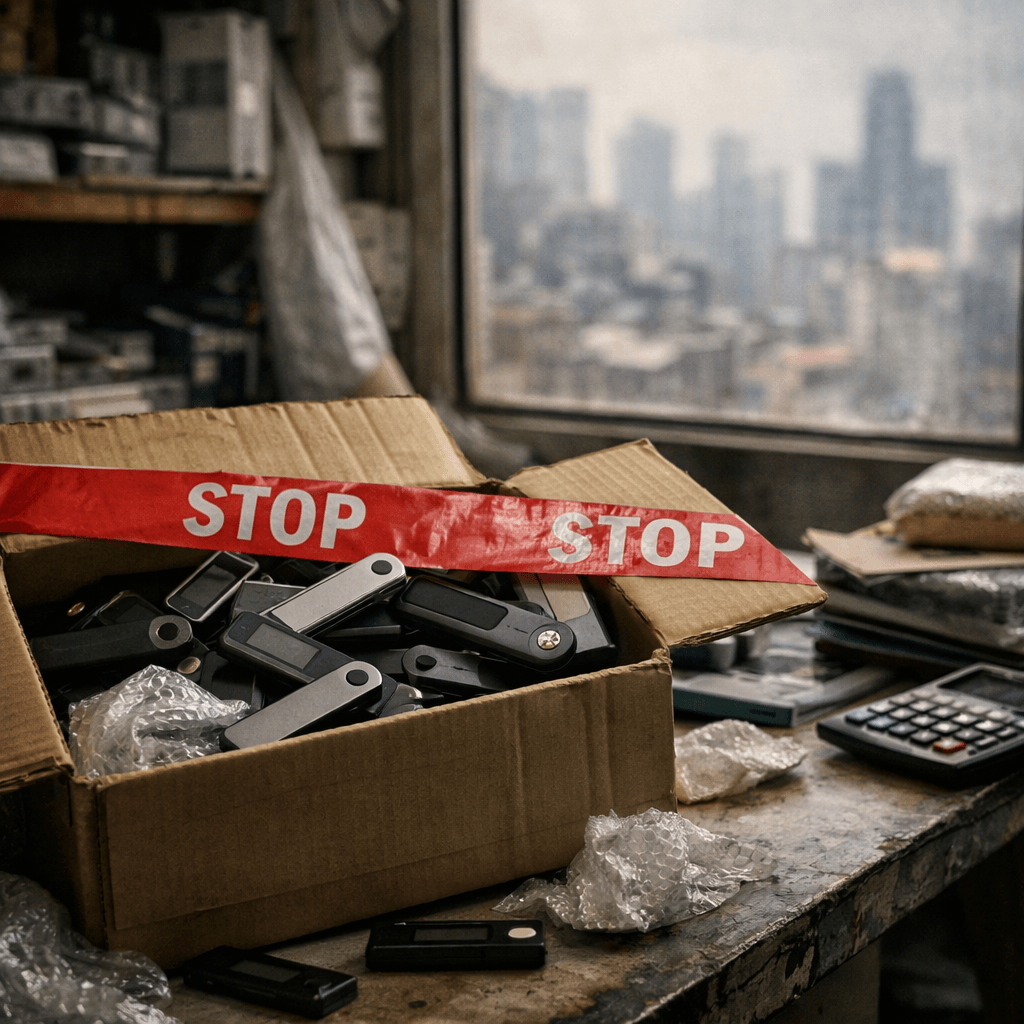
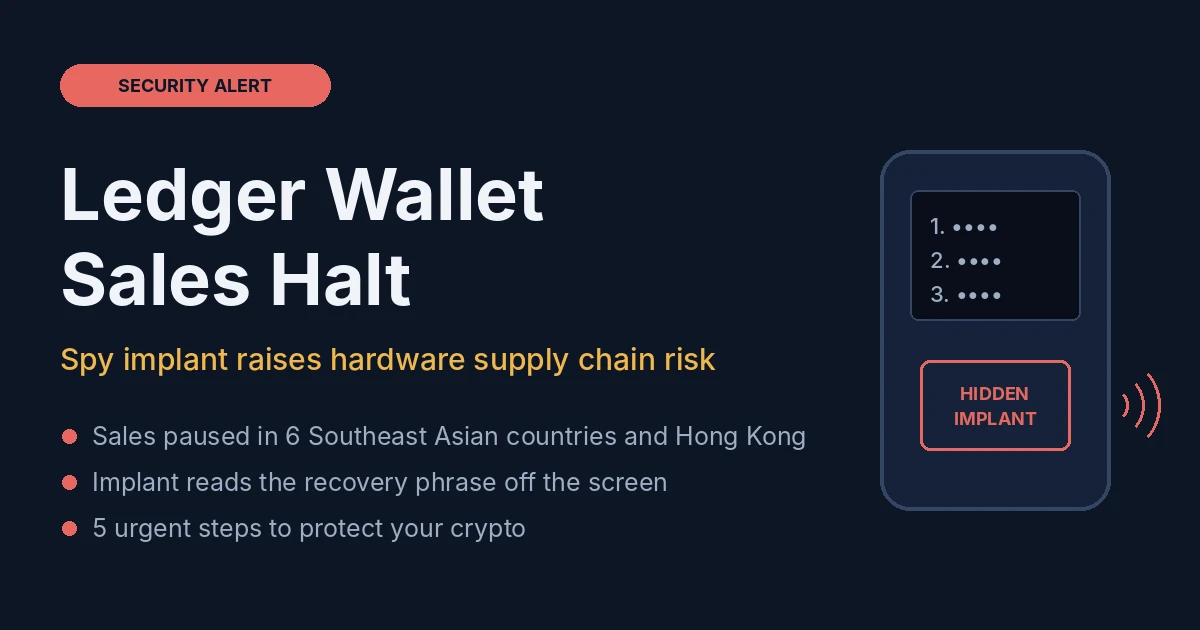
Ledger wallet sales halt widens as Ledger hardware wallet tampering exposes a potential crypto wallet supply chain attack.
The Ledger wallet sales halt turned a single-reseller problem into a regional distribution crisis in just four days.
The company opened its investigation into fund losses linked to reseller CryptoBilis on October 9. By October 13, it had asked distributors in six Southeast Asian countries and Hong Kong to stop selling its devices and pull them from shelves (Cointelegraph).
In the Ledger wallet sales halt, the sequence matters more than the map. A withdrawal this wide signals that investigators have not yet pinpointed where custody of the affected stock broke down.
The wallet maker says it has “no indication” that its infrastructure, systems, services or direct sales channel were compromised. That narrows the immediate threat, but it leaves the central question open.
How many devices passed through the same warehouses, logistics chain or return process before reaching buyers? For customers, the risk now sits in provenance, not blockchain software.
The Ledger wallet sales halt also breaks a comfortable assumption: that an authorized retailer is as safe as buying from the manufacturer. CryptoBilis was an official reseller in Indonesia, Malaysia and the Philippines (The Block).
On October 13, the company’s Donjon security team confirmed that devices sold through CryptoBilis contained an unauthorized LTE implant. It captures the 24-word recovery phrase during setup and sends it out through a provisioned eSIM (The Block).
Researchers at Tibane Labs described a professionally made flex circuit board hidden behind the screen. Tampered units were reportedly sold for nearly half the normal price (BleepingComputer).
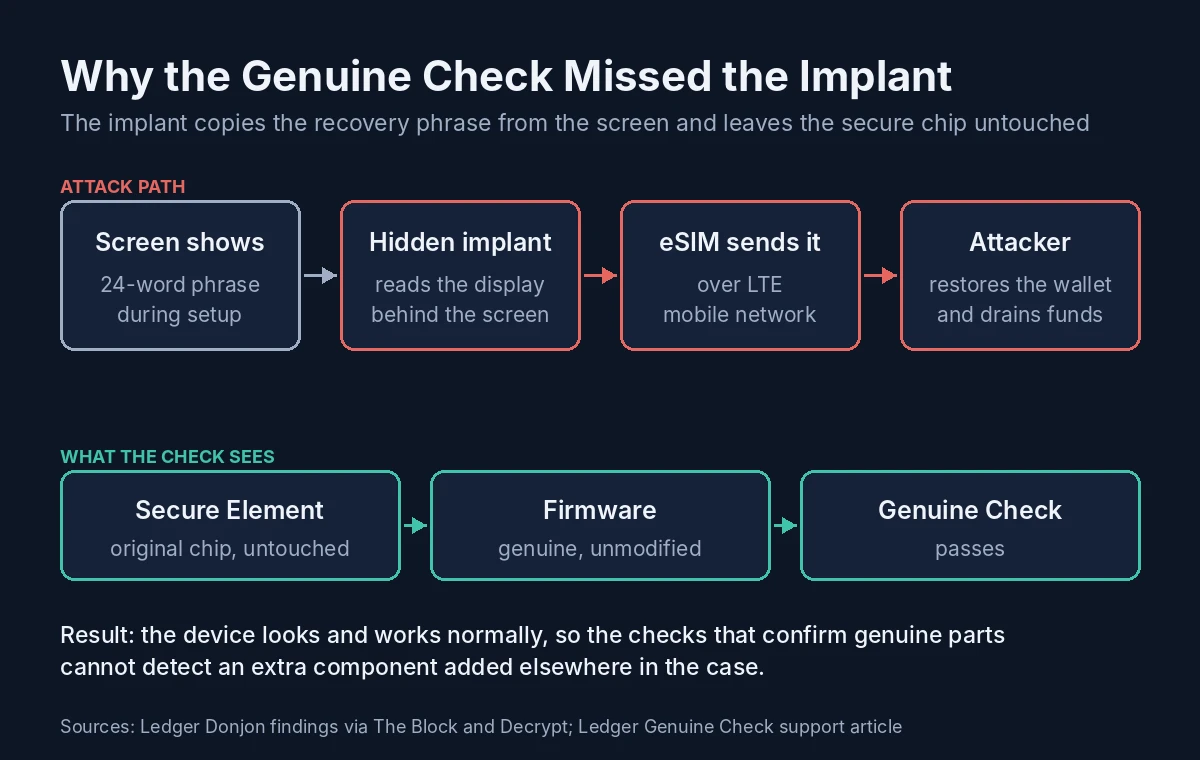
Crucially, the implant left the original Secure Element and operating system untouched. The official Genuine Check confirms genuine parts, but it cannot detect an added component when the secure chip is intact.
That separates device authenticity from device integrity. The control that matters is no longer a seal or a software check alone. It is an auditable chain of custody from assembly to activation.
The Ledger wallet sales halt now covers Indonesia, Singapore, Thailand, the Philippines, Vietnam, Malaysia and Hong Kong. Sellers were asked to suspend new sales and remove existing stock while investigators trace where tampering occurred.
Public loss estimates range from about $72 million to more than $100 million. On-chain researchers produced those figures, and the company says it has not verified them or a final victim count.
That gap deserves emphasis. On-chain tracing can flag suspicious addresses, but it cannot prove that every transfer came from the same implant.
The stronger evidence concerns the physical attack and its link to CryptoBilis. Buyers from that reseller in the past 90 days were told not to set up unused devices, and to move funds to a new seed if setup had already happened.
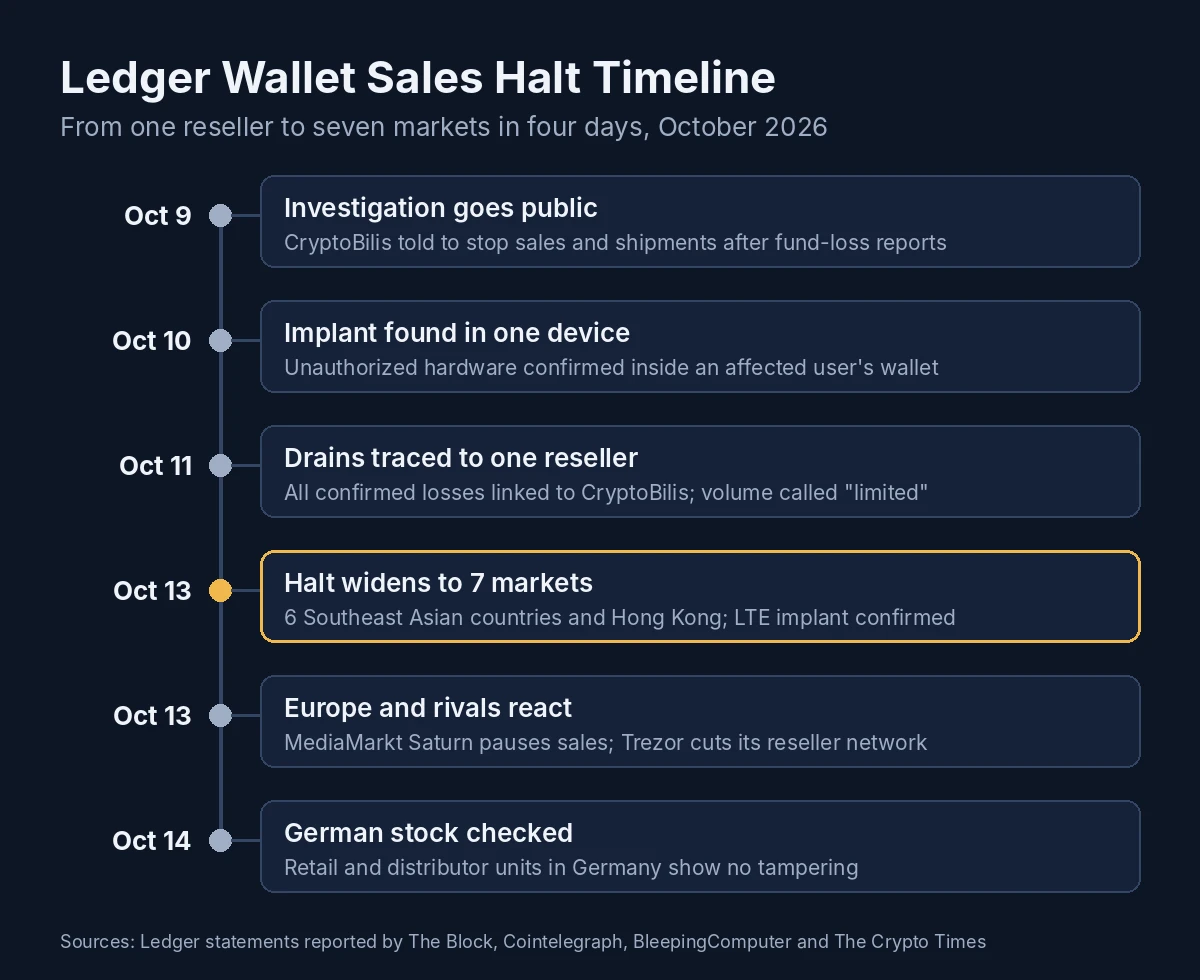
Not on confirmed evidence, so far, though the Ledger wallet sales halt has already rippled into European retail. MediaMarkt Saturn paused sales of the devices on October 13 after a German customer reported an implant, with no reported loss of funds.
On October 14, the company said it had inspected retail and distributor stock across Germany and found no tampering. It also said no implant-related losses had been reported in Europe (The Crypto Times).
Community reports are wider. A public catalog run by former Mt. Gox CEO Mark Karpelès lists 15 devices from nine sellers in Asia and Europe, across several models. None of those entries has been verified by the manufacturer yet.
The scale of the Ledger wallet sales halt reflects precaution, not proof that every unit in seven markets is at risk. That should temper both panic and complacency.
A hardware wallet is a signing device, and the blockchain cannot show whether an implant copied a recovery phrase before funds moved. Investigators need purchase records, serial data, shipping paths and physical examinations alongside on-chain transparency analysis.
The Ledger wallet sales halt exposes a mismatch between cryptographic checks and physical checks. Hardware-wallet marketing has long treated a valid firmware check as a near-binary safety signal.
If an attacker leaves the secure chip alone and harvests data elsewhere, genuine firmware can sit beside hostile hardware, unnoticed.
The idea that cold storage removes counterparty risk needs serious qualification. Cold storage moves risk away from exchanges, but it shifts more responsibility onto manufacturing, distribution and setup.
Rivals are already reacting. Trezor will end its reseller authorizations on January 1, 2027, calling it a precaution, even though it says there is “not a single piece of evidence” its devices were compromised (Decrypt).
OneKey revoked CryptoBilis’s authorization and is offering free replacements for its devices bought there between March 1 and October 13. Fewer sales partners limit retail access, but they make audits and inventory checks far easier.
The Ledger wallet sales halt could reshape how wallet makers distribute security-sensitive products.
Expect more direct sales, serialized custody logs, tougher enclosures and tests that look beyond the secure chip. Retailers already face one new rule: the company has told them not to restock returned products.
Those costs may push prices up or cut regional availability, especially where buyers rely on marketplaces because direct shipping is slow. The trade-off mirrors institutional crypto adoption, where operational controls matter as much as the asset itself.
The next credible signal won’t be a general reassurance. Users need batch-level findings, a mapped point of compromise and proof that new controls catch physical changes before activation.
The Ledger wallet sales halt should change how you handle custody, not push you away from self-custody. Treat hardware provenance as a risk, alongside seed storage and transaction checks.
If you bought from CryptoBilis in the past 90 days, don’t set up an unused device. If you already set it up, move your funds to a new seed on a device bought directly from the manufacturer.
Don’t enter an existing recovery phrase into a device you can’t verify. Generate a fresh seed on trusted hardware instead.
Buying direct removes middlemen from the chain. Tampered units reportedly sold for about half price, so treat steep discounts as a warning sign.
If you lost funds, the company advises contacting law enforcement before opening the signer. And remember: it will never call, message or ask you for your 24-word phrase.
Larger portfolios can spread assets across independent devices, each with its own recovery phrase. Restoring the same phrase on several wallets copies the risk instead of spreading it.
Watch for a confirmed point of compromise, affected serial or batch ranges, reimbursement details and independent tests of new anti-tamper controls.
The Ledger wallet sales halt can end responsibly only once the company explains how altered units entered retail stock and how new safeguards prevent a repeat. Reinstating resellers without that evidence would be commercial normalization, not a technical fix.
This article is for information only and is not financial or security advice.
Clara Reyes, Markets & Data Reporter, The Chain Journal
A weekly briefing on Bitcoin price action, Ethereum, crypto market analysis, Bitcoin ETF flows, regulation, digital assets, and the narratives shaping crypto investing.
One sharp weekly read. No daily alerts. No recycled headlines.