THE CHAIN JOURNAL
Independent Crypto Editorial

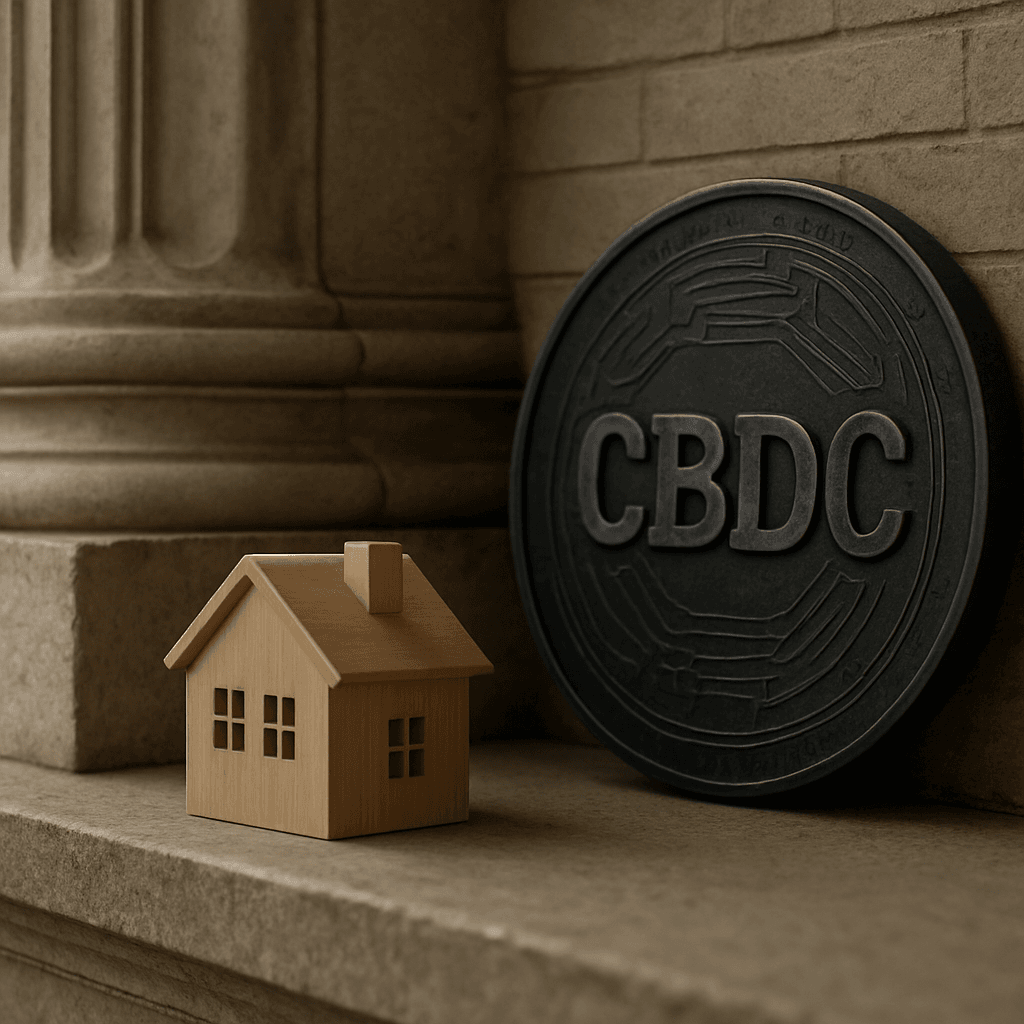
crypto regulatory update on Congress’s CBDC ban deal, with crypto policy news and bitcoin government policy implications for 2026.
The latest crypto regulatory update is not really about housing finance – it is about how far Congress is willing to go in drawing lines around money itself. A deal on the 21st Century Road to Housing Act would temporarily block a U.S. central bank digital currency through 2030, transforming a bill nominally about affordability into a broader statement on bitcoin government policy and the boundaries of state power. That matters because lawmakers rarely attach a monetary constraint of this magnitude to a housing package unless they believe the political upside justifies the policy noise. The result is a narrow legislative win with an outsized symbolic footprint, particularly for traders who treat every crypto regulatory update as a signal about where federal oversight is headed next.
The broader backdrop is not difficult to read. Washington has spent 2026 tightening its language around digital assets while trying to hand institutions something resembling regulatory clarity. The SEC’s recent interpretive shift on crypto assets suggests regulators want cleaner jurisdictional lines rather than a vacuum. The CBDC fight, however, operates on different terrain. It is less about securities doctrine and more about surveillance, privacy, and the long-running argument over whether a future public digital dollar would complement or simply crowd out private rails. Seen that way, this crypto regulatory update is as much about political psychology as it is about policy mechanics.
The practical takeaway is that crypto regulatory update headlines can move markets even when the underlying legislation does not directly target bitcoin. A housing bill is an unusual vessel for a CBDC prohibition – and that unusualness is precisely the point. It raises the odds the language survives, because stripping it out becomes politically costly when it is bundled with affordability provisions that have their own constituencies. The proposed sunset to 2030 carries its own significance. A temporary ban is not a settlement; it is a deliberate pause that pushes the real confrontation into the next Congress, when the institutional and electoral arithmetic may look entirely different. For investors, the policy signal is considerably stronger than the legal finality.
The current market structure provides useful context. Bitcoin has been trading in a broad consolidation zone rather than a defined trend regime, leaving it exposed to sharp short-term reactions whenever regulatory headlines break. That is precisely why crypto policy news keeps surfacing in price action even as macro flows dominate the larger picture. If Washington continues leaning toward clarity for private crypto rails while deferring any public digital dollar, the market may sustain a premium for assets that benefit from policy ambiguity narrowing rather than widening – a dynamic explored in depth in our Crypto Market Sentiment analysis.
This is where the narrative grows complicated. Many investors still frame the debate as a binary choice between CBDC and bitcoin, but the law rarely resolves that cleanly. The current push is better understood as a fight over institutional design. Congress is signaling that it wants to constrain the Fed before the Fed can define the terms on its own. That shifts the question away from whether a CBDC is technically feasible and toward whether the political system trusts the central bank to build one without engineering a new surveillance architecture in the process. The SEC’s evolving posture, tracked through SEC crypto regulation, reflects the same preference – definitional clarity over open-ended discretion.
The choice of a housing vehicle also tells a story. Lawmakers want to pair a high-voltage digital-money issue with a bill that carries a different public purpose and a wider coalition behind it. It is a classic legislative maneuver: attach a contentious clause to a high-profile package, then raise the cost of stripping it out during conference. For bitcoin legal watchers, the critical point is not that bitcoin itself is being regulated here. What matters is that Congress is normalizing the idea that digital-money policy belongs in must-pass legislation – and that pattern raises the probability of further cross-linked fights over custody rules, payment rails, and reserve design before the year is out.
Investors who still treat regulatory headlines as background noise are misreading the current environment. A crypto regulatory update of this kind is a macro variable now, not a footnote. If the housing deal holds, it would reinforce the market’s working preference for private-sector digital asset infrastructure over any federally issued alternative, at least through 2030. That does not make bitcoin automatically bullish on a straight-line basis. What it does do is remove one source of policy uncertainty while keeping other risks – taxation, exchange supervision, custody standards – very much in play. In a market already sensitive to liquidity conditions, that distinction carries real weight.
The larger question is what Congress reaches for next. Watch whether the CBDC language survives conference negotiations intact, whether the SEC continues sharpening its crypto framework, and whether House and Senate leaders keep pairing financial-technology provisions with unrelated bills. The next crypto regulatory update may arrive not from a standalone crypto bill, but buried inside legislation that looks entirely different on the surface.
Focus: crypto regulatory update headlines matter most when they shift the state’s role in money – not merely its attitude toward tokens.
Arianna Vaz, Portfolio Strategy Analyst, The Chain Journal
A weekly briefing on Bitcoin price action, Ethereum, crypto market analysis, Bitcoin ETF flows, regulation, digital assets, and the narratives shaping crypto investing.
One sharp weekly read. No daily alerts. No recycled headlines.