THE CHAIN JOURNAL
Independent Crypto Editorial

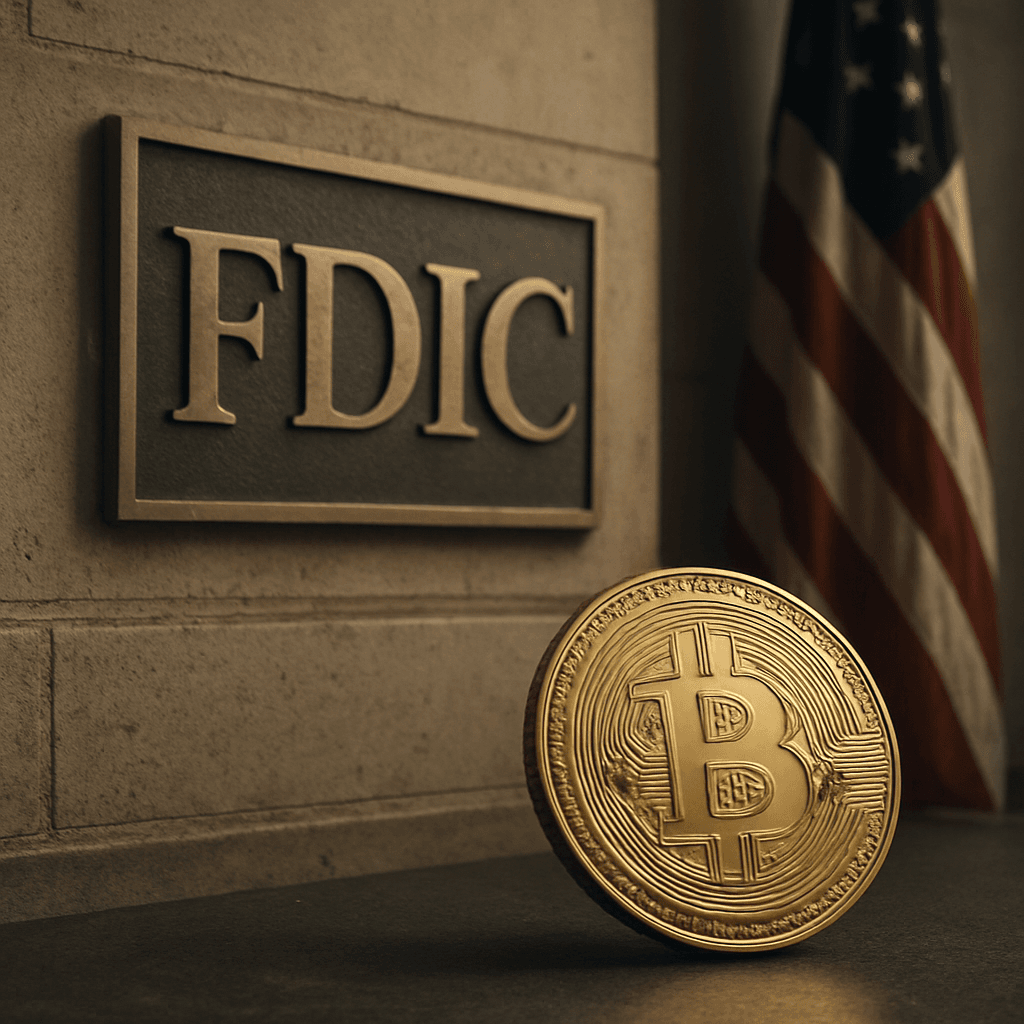
crypto regulatory update: GAO flags FDIC gaps as crypto policy news and bitcoin government policy sharpen the 2026 oversight debate.
A new crypto regulatory update from Washington is not really about one memo at the FDIC. It is about a larger, more persistent problem: the U.S. still lacks a durable mechanism for coordinating responses when blockchain risk migrates from the periphery into the banking core. The Government Accountability Office says regulators are missing an “ongoing coordination mechanism” for those risks – the kind of language that tends to surface when process has fallen badly behind market reality. For investors, that matters because crypto policy news increasingly draws the boundary between what banks can support, what exchanges can scale, and what institutions are actually willing to carry on their balance sheets.
The timing is awkward. Markets have spent much of 2026 operating on the assumption that clarity would arrive through formal rules rather than supervisory warnings. Yet every crypto regulatory update seems to confirm the same uncomfortable truth: policy is moving, but not in a straight line. Banks can still engage with digital assets under narrow conditions, yet the supervisory architecture remains fragmented enough that one agency’s comfort offers no guarantee of systemwide consistency. That gap grows more consequential as tokenized deposits, stablecoins, custody, and settlement all begin running on the same rails.
The practical signal buried inside this crypto regulatory update is not a ban. It is a reminder that the U.S. still governs digital assets through overlapping silos – and overlap creates delay. The FDIC, the Fed, the OCC, the SEC, and the CFTC each control a different corner of the picture, and without a standing coordination mechanism, the odds rise of uneven examinations, conflicting guidance, and sluggish responses when products evolve faster than rulemaking can follow. In that sense, the watchdog is pushing for better institutional plumbing, not a new headline policy.
That distinction matters. The industry has already seen how sharply policy clarity can redirect capital allocation. Recent market behavior has been shaped by the prospect of cleaner banking access, stronger custody standards, and a more predictable path for tokenization. Even so, the broader crypto regulation 2026 framework remains visibly incomplete. If regulators want to break the familiar cycle of ad hoc enforcement followed by retroactive guidance, they need a shared playbook before the next stress event – not after it. That is the real takeaway from this latest crypto regulatory update.
Markets keep framing regulation as a binary: friendlier or harsher. That framing is too simple. The deeper question is whether supervision can be coherent enough to support scale. A bank can navigate one clear set of crypto rules; it struggles when multiple agencies interpret the same activity in fundamentally different ways. The result is added cost, slower product launches, and a quiet incentive to route activity through whichever jurisdiction applies the least scrutiny. Fragmented oversight, in practice, can be just as restrictive as a formal crackdown – even when policymakers are genuinely trying to be accommodating.
There is a second-order effect worth naming. When regulators fail to coordinate, risk doesn’t disappear – it migrates to the least supervised corners of the market. That is precisely where the comparison with stablecoin regulation 2026 becomes instructive: stablecoins and bank-linked digital cash demand consistent treatment because payment, settlement, and reserve management are rapidly converging. Investors should resist assuming that more guidance automatically means more freedom. Sometimes it means sharper lines, tighter boxes, and fewer gray areas for experimentation. A serious crypto regulatory update often narrows the path before it widens it.
The SEC provides a useful reference point here. It has already moved to clarify how federal securities laws apply to certain crypto assets and transactions – a direction that doesn’t resolve bank-supervision gaps but does signal Washington’s slow drift toward a more legible framework. Read alongside strong ETF institutional inflows, the message is clear enough: institutions want rules they can price, not slogans they can quote. The operational question is whether regulators can now meet that demand with a supervisory model that actually holds together under pressure.
For investors, this crypto regulatory update calls for a more selective posture – not a more cynical one. Regulation is no longer just a headline risk. It is becoming a cash-flow variable, a custody variable, and a valuation multiple. Assets and businesses that depend on clean institutional access stand to benefit if coordination improves, but they may also face stricter documentation requirements, more conservative oversight, and longer rollout timelines. Put plainly, clarity and friction can arrive in the same package.
Three things are worth watching closely: agency statements on cross-regulator coordination, bank participation in crypto custody and settlement infrastructure, and any legislative movement that meaningfully reduces supervisory ambiguity. If those signals improve in tandem, the market can begin pricing a cleaner runway for tokenized finance. If they stall, the most defensible trade may still be the one the market already knows how to underwrite.
Focus: The real crypto regulatory update is not tighter rules – it is the absence of a shared operating system for enforcement.
Monica Ramires, Senior Markets Analyst, The Chain Journal
A weekly briefing on Bitcoin price action, Ethereum, crypto market analysis, Bitcoin ETF flows, regulation, digital assets, and the narratives shaping crypto investing.
One sharp weekly read. No daily alerts. No recycled headlines.