THE CHAIN JOURNAL
Independent Crypto Editorial

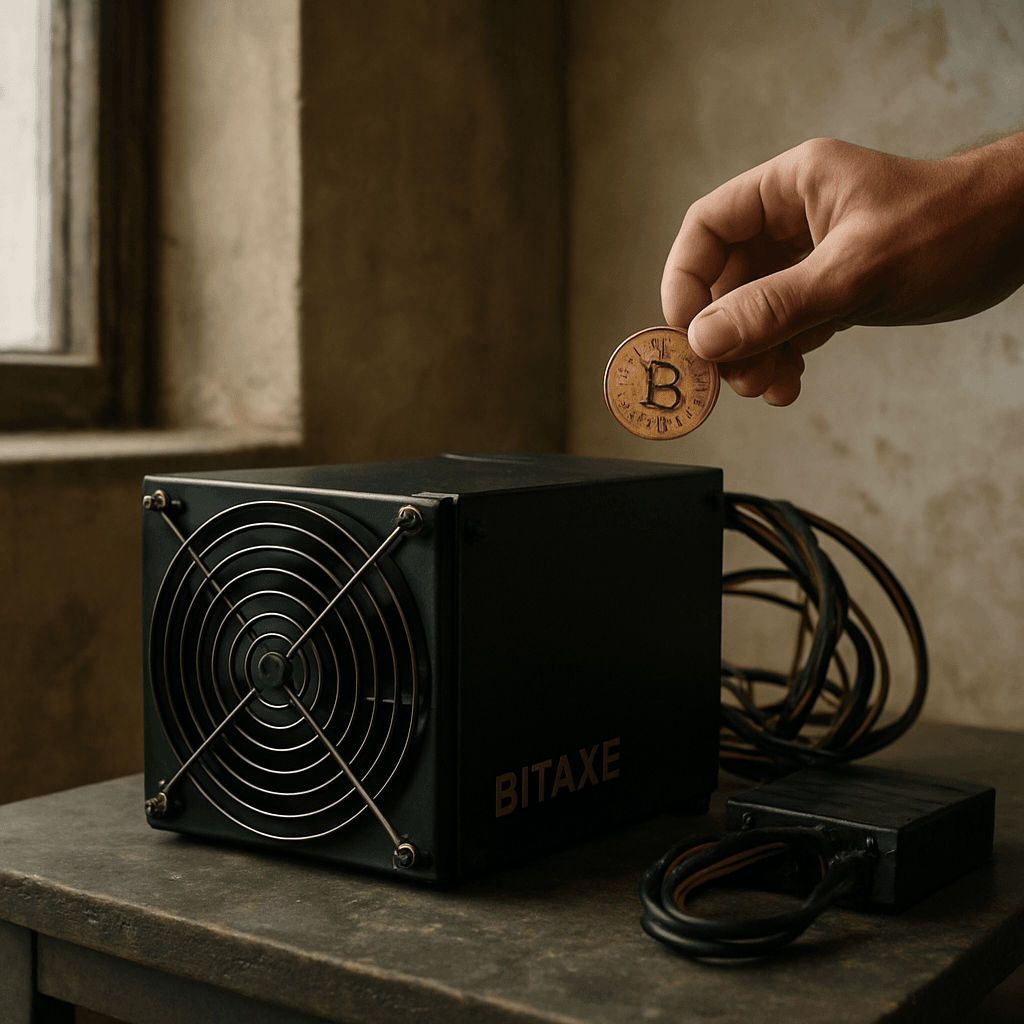
bitcoin solo mining gets a fresh test case as a bitaxe miner lands a solo bitcoin block and lifts home mining debate.
Bitcoin solo mining just produced another reminder that the network still occasionally rewards the smallest participant with the largest outcome. A hobby-level miner reportedly landed a $200,000 block using a budget Bitaxe rig – a result that reads less like a commercial model and more like a statistical outlier with a clean philosophical punchline. The headline sounds romantic, but the math stays brutal: a tiny machine can win, yet expected value here is dominated by variance, not steady income.
That is precisely why bitcoin solo mining keeps attracting attention even when the odds look absurd. The most interesting part isn’t the payout itself – it’s the signal it sends about accessibility. A few years ago, home mining mostly meant experimentation on the margins. Now, a modest open-source setup can still participate directly in block discovery, even if the chance of success sits closer to a lottery ticket than a business plan. The appeal is sovereignty, tinkering, and optionality. Predictable yield was never the point.
The current subsidy stands at 3.125 BTC per block. At recent market prices, that reward lands near $200,000 before transaction fees nudge it a little higher. For a hobbyist whose hardware cost is a fraction of that figure, every successful block is a meaningful event. Recent solo wins have come from devices with only modest hashpower, yet they still occasionally beat odds that can run into the tens of millions on a daily basis. The prize is large because the network pays a fixed subsidy – not because anything about the winning miner’s operation was economically scalable.
For readers tracking the broader context, the structural backdrop matters as much as the luck factor. Network difficulty remains elevated, the professional mining sector continues consolidating, and industrial operators keep hunting thinner margins through scale, energy arbitrage, and financing discipline. As tracked by Bitcoin mining metrics, the data reveals a network that has grown far more competitive even as the block reward stays mechanically simple. That tension explains why bitcoin solo mining survives as both a hobby and a cultural statement: the protocol allows it, but the market rarely rewards it on purpose.
The market keeps misreading bitcoin solo mining as a story about beating the odds, when the more important lesson is about distribution. Bitcoin’s protocol doesn’t care whether hashpower comes from a warehouse or a desktop-sized rig – it only cares that valid work gets submitted. That makes the system unusually democratic in theory, yet the economics still concentrate power in industrial operations, because large miners can absorb volatility, lock in cheap power, and smooth revenue through pools. That is the real divide: not technical permission, but financial durability.
A useful way to frame the event is to contrast it with the mainstream mining model. Pool mining converts variance into steady, smaller payouts. Solo mining keeps the full upside and absorbs the full downside. The Bitaxe story therefore says more about Bitcoin’s design than about any particular miner’s strategy. It proves that protocol-level access remains open while underscoring just how rare it is for a household setup to prevail against network-scale competition. The win is evidence of possibility, not repeatability. As our Bitcoin macro analysis has noted, block economics and market structure now move in opposite directions more often than they converge – and this story illustrates that gap perfectly.
For investors, bitcoin solo mining matters less as an income opportunity and more as a reminder that Bitcoin’s architecture still preserves open participation. The hobbyist win reinforces a broader point: the protocol keeps rewarding proof of work, but the payout profile is shaped by extreme randomness and an increasingly professional mining backdrop. Approach bitcoin solo mining as a business and the numbers remain unattractive. Approach it as experimentation, education, or a sovereignty signal, and the logic becomes considerably cleaner.
What to watch next is straightforward – hash rate, difficulty adjustments, and whether open-source rigs continue appearing in solo win reports. If the gap between home hardware and industrial miners narrows even slightly, more of these stories will surface, though the economics will still favor scale. The deeper question is whether bitcoin solo mining grows into a meaningful cultural niche or remains what it has largely always been: a highly visible exception that the market can’t quite stop talking about.
Focus: Bitcoin solo mining is still a lottery, but every rare win reminds the market that Bitcoin was built to stay open at the protocol level.
Monica Ramires, Senior Markets Analyst, The Chain Journal
A weekly briefing on Bitcoin price action, Ethereum, crypto market analysis, Bitcoin ETF flows, regulation, digital assets, and the narratives shaping crypto investing.
One sharp weekly read. No daily alerts. No recycled headlines.




