THE CHAIN JOURNAL
Independent Crypto Editorial


bitcoin market update on falling retail flows, bitcoin price analysis, and what futures selling signals for the next BTC leg.
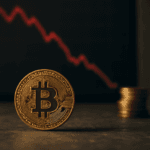
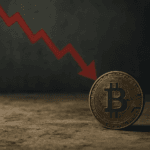
In this bitcoin market update, the first thing to note is that retail demand hasn’t simply softened – it has been retrenched. Bitcoin’s drop under the $77,000 level matters less as a clean chart break than as evidence that marginal buyers are stepping back precisely when futures sellers lean harder. That combination typically carries more weight than any single headline candle, because it signals a market with shrinking absorption capacity. In practical terms, the bitcoin price analysis now hinges on whether spot demand can stabilize before derivatives pressure becomes self-reinforcing. When that balance breaks, prices can move faster than sentiment models anticipate – especially when traders treat every bounce as an opportunity to reduce risk rather than add it. The current bitcoin market update looks exactly like that kind of market.
The broader setup also argues against reading this as a routine dip. Retail flow at Binance has fallen to record-low territory, and the decline in 30-day net demand has been steep enough to suggest a structural pause rather than a short-lived lull. That matters because Bitcoin typically needs a blend of spot demand, ETF support, and thinner sell-side pressure to extend a rally. When one of those pillars weakens, the others must work harder to compensate. The bitcoin outlook therefore looks more fragile than price-only traders may be willing to admit. A market can absorb weak positioning for a while, but it rarely ignores it indefinitely when leverage is doing most of the heavy lifting.
The data point that deserves serious attention is the scale of futures selling, which has topped roughly $2B during this move. That is not a trivial flow – it is the kind of pressure that can overpower steady spot buying and compress rebounds before they have a chance to mature. Adding to the difficulty, recent market readings showed U.S. spot Bitcoin ETF flows turning uneven, stripping away an important buffer from the tape. Bitcoin has also struggled to sustain momentum even when broader crypto risk appetite improves, which tells us the issue is not purely macro. It is also microstructure. As tracked by futures liquidations derivatives data, leverage can make selling appear larger than it would in a cash-only market, and that dynamic frequently exaggerates downside once trend followers begin chasing the move.
The key takeaway from this bitcoin market update is that the market is behaving like a crowded, low-conviction tape rather than a clean trend reversal. There is a meaningful difference between a pullback driven by profit-taking and one driven by active distribution – and the available evidence leans toward the latter. When retail inflows weaken at the same moment that futures sellers dominate, the market loses two layers of support simultaneously. That is why the present bitcoin price today matters less as a standalone figure than as a battleground between passive dip buyers and active short sellers. Recovery from this setup is possible, but it generally requires either a sharp improvement in spot demand or a decisive flush that resets leverage across the board.
This bitcoin market update deserves a more skeptical reading than the usual “buy the dip” reflex. Much of the prevailing commentary still treats every decline as an invitation for long-term accumulators, but that thesis only holds if buyers arrive with enough scale to offset forced selling. Right now, the evidence suggests they are not. The bitcoin price analysis points to a market where narrative remains stronger than flow – and that is often the terrain where bear phases begin quietly reasserting themselves. That does not mean a full cycle top is in place. What it does mean is that the burden of proof has shifted decisively to the bulls. If Bitcoin cannot reclaim lost ground in short order, traders will increasingly treat rallies as supply events rather than trend confirmation.
Structure, in this environment, matters more than mood. Large holders can accumulate while retail hesitates, and that kind of divergence can eventually underpin a rebound. But recoveries built on hidden accumulation tend to be slower and more selective than the euphoric advances traders remember from stronger phases of the cycle. The internal question now is whether the market is experiencing a temporary demand pause or the beginning of a more durable risk-off shift. The crypto market sentiment framework suggests that sentiment can stay weak far longer than price-first traders expect, particularly when derivatives are doing the heavy lifting. In that light, the present bitcoin market update is less about drama and more about patience.
For investors, this bitcoin market update argues for discipline over conviction-by-slogan. The market does not need a dramatic collapse to punish aggressive longs – it only needs a stretch of thin demand and persistent sellers. That is precisely why the next phase of the bitcoin outlook depends on whether spot buyers return with real conviction or whether the market continues drifting lower on fading liquidity. A sound bitcoin price analysis in this environment begins with position sizing, not price targets. For traders who insist on holding a directional view, the minimum requirement is respecting the fact that leverage has become the dominant short-term variable.
The indicators worth watching are straightforward: spot ETF flows, exchange inflows from large holders, and whether Bitcoin can reclaim nearby resistance without running into immediate rejection. The bitcoin price today will register, but the flow behind it will tell the more honest story. If demand firms while sellers lose conviction, stabilization can come quickly. If neither condition materialises, this bitcoin market update may prove to be the opening chapter of a longer consolidation.
Focus: bitcoin market update shows bears need only thin demand, not panic, to win.
Clara Reyes, Markets & Data Reporter, The Chain Journal
A weekly briefing on Bitcoin price action, Ethereum, crypto market analysis, Bitcoin ETF flows, regulation, digital assets, and the narratives shaping crypto investing.
One sharp weekly read. No daily alerts. No recycled headlines.