THE CHAIN JOURNAL
Independent Crypto Editorial


October’s bitcoin ETF outflows exceed $1B as ethereum ETF outflows deepen, reshaping bitcoin ETF flows and portfolio risk.
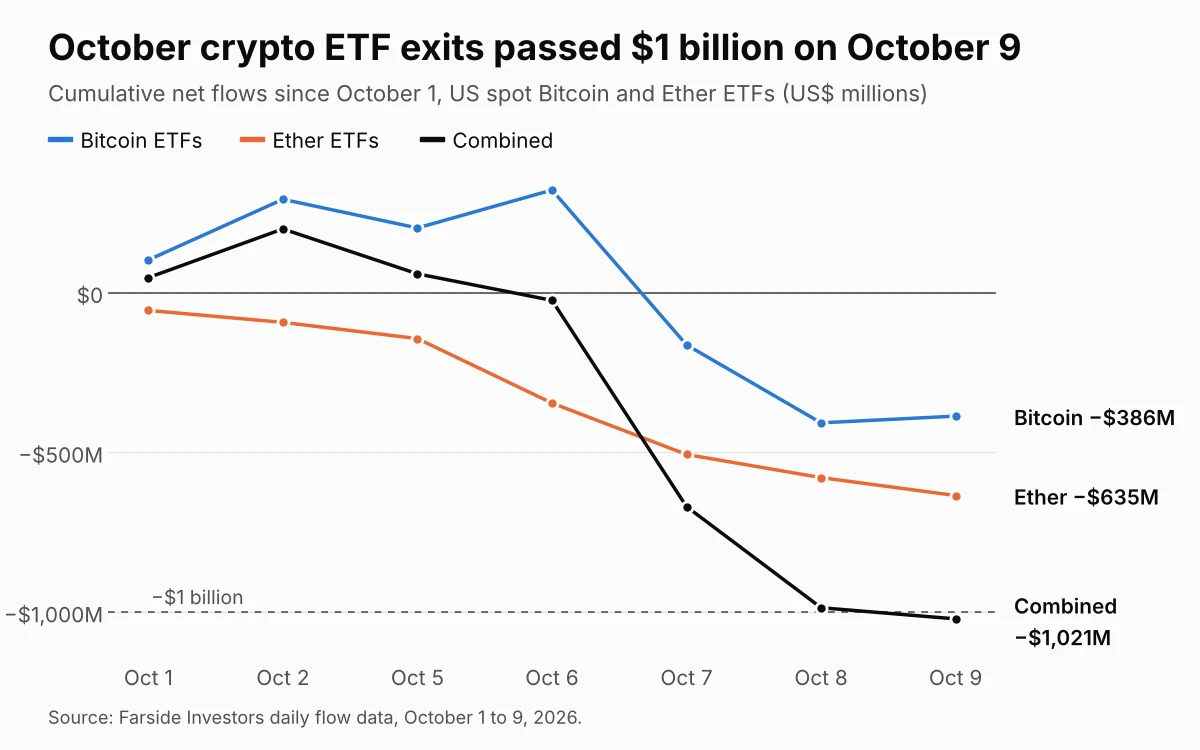
Bitcoin ETF outflows helped push October’s combined BTC and Ether fund withdrawals past $1 billion, replacing the season’s usual optimism with a harder portfolio question.
Through October 8, investors pulled about $986 million from the two categories. On October 9, Ether funds shed another $56 million while BTC products took in only $21 million, lifting the combined total to roughly $1.02 billion (Farside Investors).

The scale matters, but the sequence matters more. BTC funds opened October with two positive sessions and a choppy week before heavy selling hit on October 7 and 8.
Ether products, by contrast, recorded outflows on every trading day of the month so far.
That divergence suggests investors have not abandoned digital assets wholesale. They appear to be cutting risk where conviction feels weakest, liquidity looks thinner and opportunity costs have climbed. For diversified portfolios, this looks more like reassessment than capitulation.
These Bitcoin ETF outflows followed a three-week run of inflows in late September. That shows how quickly institutional positioning can shift when macro expectations move.
BTC funds lost about $485 million on October 7 and another $244 million on October 8. The price slid to about $80,500 on October 8 before recovering to roughly $82,900 by October 10 (Bitcoin.com News).
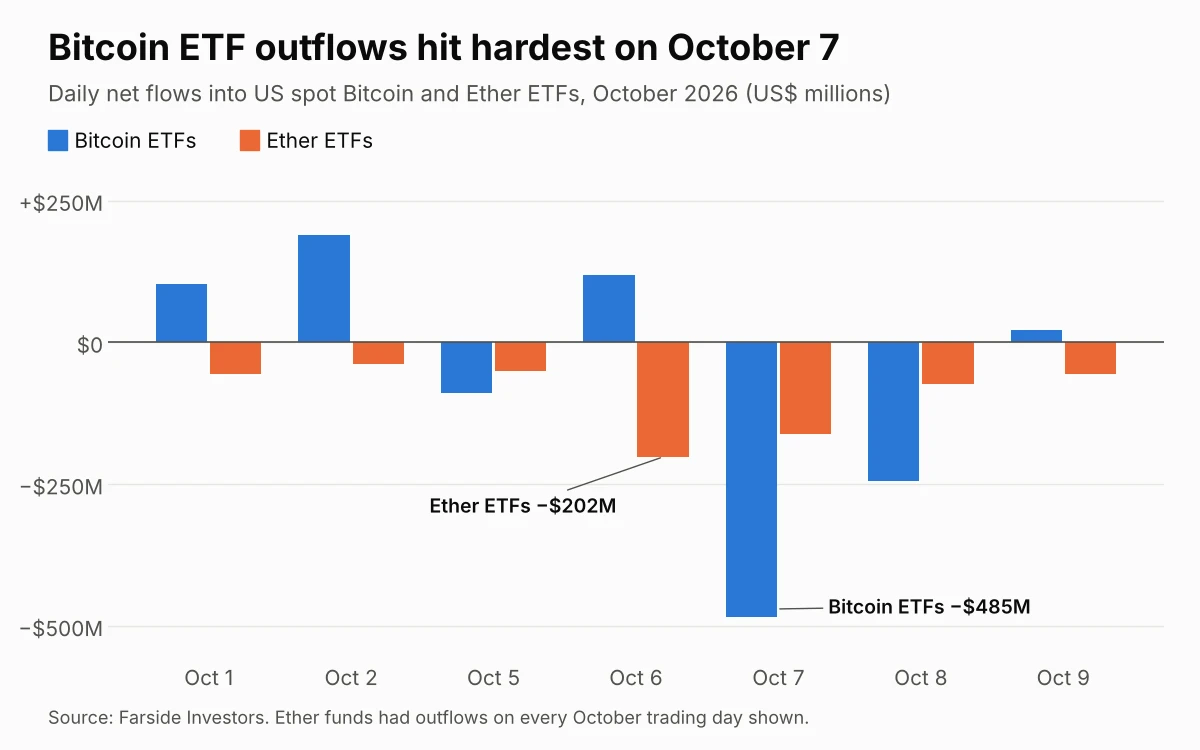
Ether faced more persistent pressure. Nine straight negative sessions stripped about $697 million from Ether funds between September 29 and October 9 (Farside Investors).
The selling was concentrated, not spread evenly. BlackRock’s iShares Ethereum Trust (ETHA) accounted for about 88% of last week’s Ether fund outflows (The Block).
That concentration can amplify daily volatility. It also cautions against reading every redemption as a permanent rejection of the asset class.
Bitcoin ETF outflows create a direct liquidity headwind. Fund redemptions can require authorized participants to reduce underlying exposure, and the math is simple.
Yet daily flows and price don’t move on a mechanical track. BTC funds absorbed about $729 million in net withdrawals across October 7 and 8, then posted a small positive session on October 9.
That stabilization didn’t erase the month’s deficit. It did show that selling intensity can shift faster than monthly totals suggest.
Investors should weigh the flows against spot-market depth, derivatives funding rates and the behavior of long-term holders. Our guide to institutional BTC ETF flows explains how to separate strategic allocation from short-term positioning.
Macro pressure added to the selling. The October 7 Federal Reserve minutes kept interest-rate uncertainty at the center of portfolio decisions.
On October 8, rising oil prices and Middle East tensions pushed crypto liquidations above $1.1 billion in 24 hours, according to the same report.
Higher real yields raise the hurdle for assets with no contractual cash flow. Choppy markets also push institutions to defend quarterly performance.
BTC funds still held about $494 million in net ETF inflows for 2026 after the latest weekly reversal, down from $1.18 billion a week earlier (The Block). The annual allocation story remains positive, if fragile.
Treating every redemption wave as an automatic sell signal mistakes flows for a complete investment thesis.
ETFs capture an important slice of demand. They don’t measure offshore trading, corporate treasury buying, direct custody or long-term accumulation.
The more useful question is whether withdrawals confirm broader weakness or simply reflect tactical de-risking.
BTC held the $80,000 to $83,000 zone through the month’s heaviest Bitcoin ETF outflows. That offers some evidence of underlying demand, but it falls well short of a durable floor.
Portfolio managers should look for confirmation: lower volatility, improving market breadth and less selling across issuers. One positive day proves little. Several sessions of balanced flows with firmer prices would be a far more credible signal.
For Ether, the picture looks less comfortable. Its nine-session withdrawal streak shows a sharper conviction gap between the two leading assets.
Large allocators often trim satellite positions before touching core exposure, especially when volatility rises. In many institutional crypto portfolios, BTC is the core holding and Ether sits in a growth sleeve.
That hierarchy can magnify Ether redemptions during risk-reduction episodes. Ether ETFs’ 2026 net inflows fell to about $932 million, from $1.47 billion a week earlier (The Block).
Our analysis of crypto liquidity conditions explains why thinner market depth can turn modest rebalancing into outsized price moves.
If Ether funds keep losing capital while Bitcoin ETF outflows ease, read the divergence as active portfolio selection, not a uniform exit from crypto.
The current Bitcoin ETF outflows argue for disciplined position sizing, not emotional selling.
Start by deciding whether crypto is a strategic allocation, a tactical trade or a high-volatility satellite position. Each role calls for a different response.
The October data favors BTC on relative resilience. That advantage does not remove downside risk.
Any portfolio built on a single story, whether seasonality, institutional adoption or expected rate cuts, stays exposed when sentiment shifts faster than the thesis.
Track the next round of Bitcoin ETF outflows alongside three concrete signals.
The October 8 low near $80,500 is the line to watch. A clean break below $80,000 with continued ETF selling would point to deeper deleveraging.
One positive Ether session would not change the trend. A run of flat or positive days would show that the trimming phase is ending.
So far, a few large funds carry most of the selling. If outflows spread across every issuer, the move is broader than a few allocators rebalancing.
Improving prices with neutral flows would suggest sellers are losing influence. Falling prices with faster withdrawals would point to continued deleveraging.
The trend across several sessions will always tell a more honest story than any single dramatic day.
This article is market analysis, not financial advice. Crypto assets are volatile and you can lose money.
Arianna Vaz, Portfolio Strategy Analyst, The Chain Journal
A weekly briefing on Bitcoin price action, Ethereum, crypto market analysis, Bitcoin ETF flows, regulation, digital assets, and the narratives shaping crypto investing.
One sharp weekly read. No daily alerts. No recycled headlines.