THE CHAIN JOURNAL
Independent Crypto Editorial

Tesla crypto payments are back in the spotlight. The carmaker unveiled its next-generation Roadster on October 15, 2026, with production targeted for 2028, and crypto holders immediately asked the same thing: can Bitcoin pay for it?
Today the answer is no. The bigger question is whether Bitcoin, or more likely stablecoins, could ever become a practical way to buy a six-figure supercar.
For the Roadster’s price, specs and trims, see our Tesla Roadster 2026 guide. This article looks at the payment side.
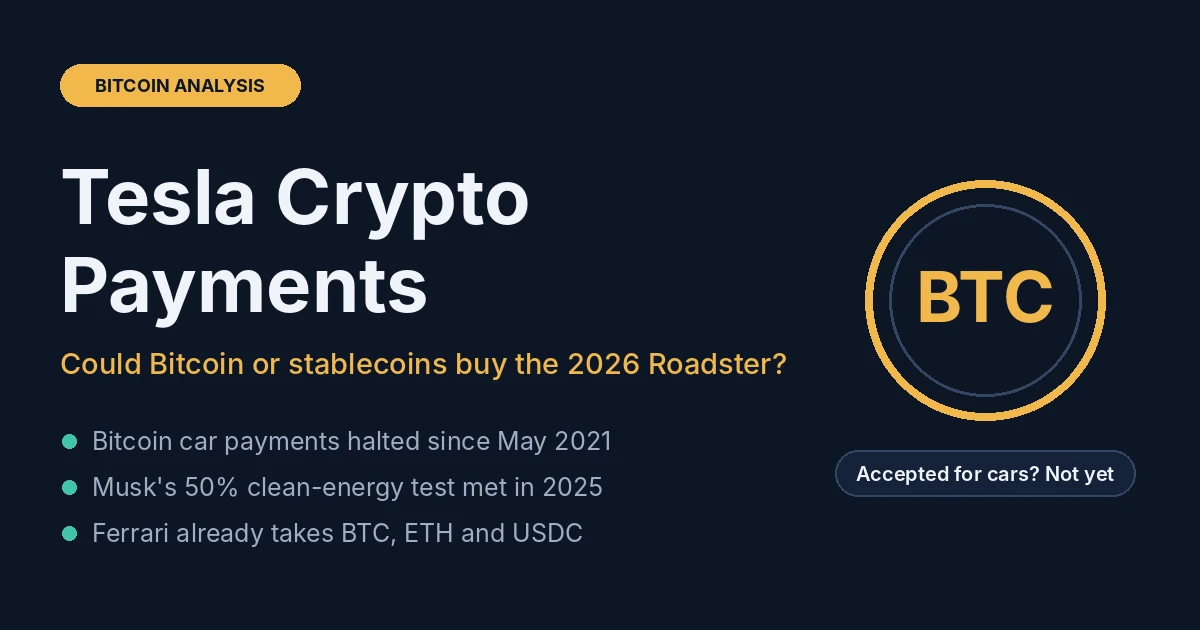
The company only accepts Dogecoin, and only for eligible items in its online shop. Its support page says it “cannot receive or detect any other digital assets” (official Dogecoin support page).
Tesla crypto payments don’t extend to Roadster reservations either. Those cost $50,000 for the Performance trim and $250,000 for Thrust (TechCrunch).
It wasn’t always this way. In early 2021 the company bought about $1.5 billion of Bitcoin and briefly let US buyers pay for cars in BTC (CoinDesk).
Bitcoin car payments lasted about six weeks. In May 2021, Musk suspended them, citing the fossil fuels used in Bitcoin mining.
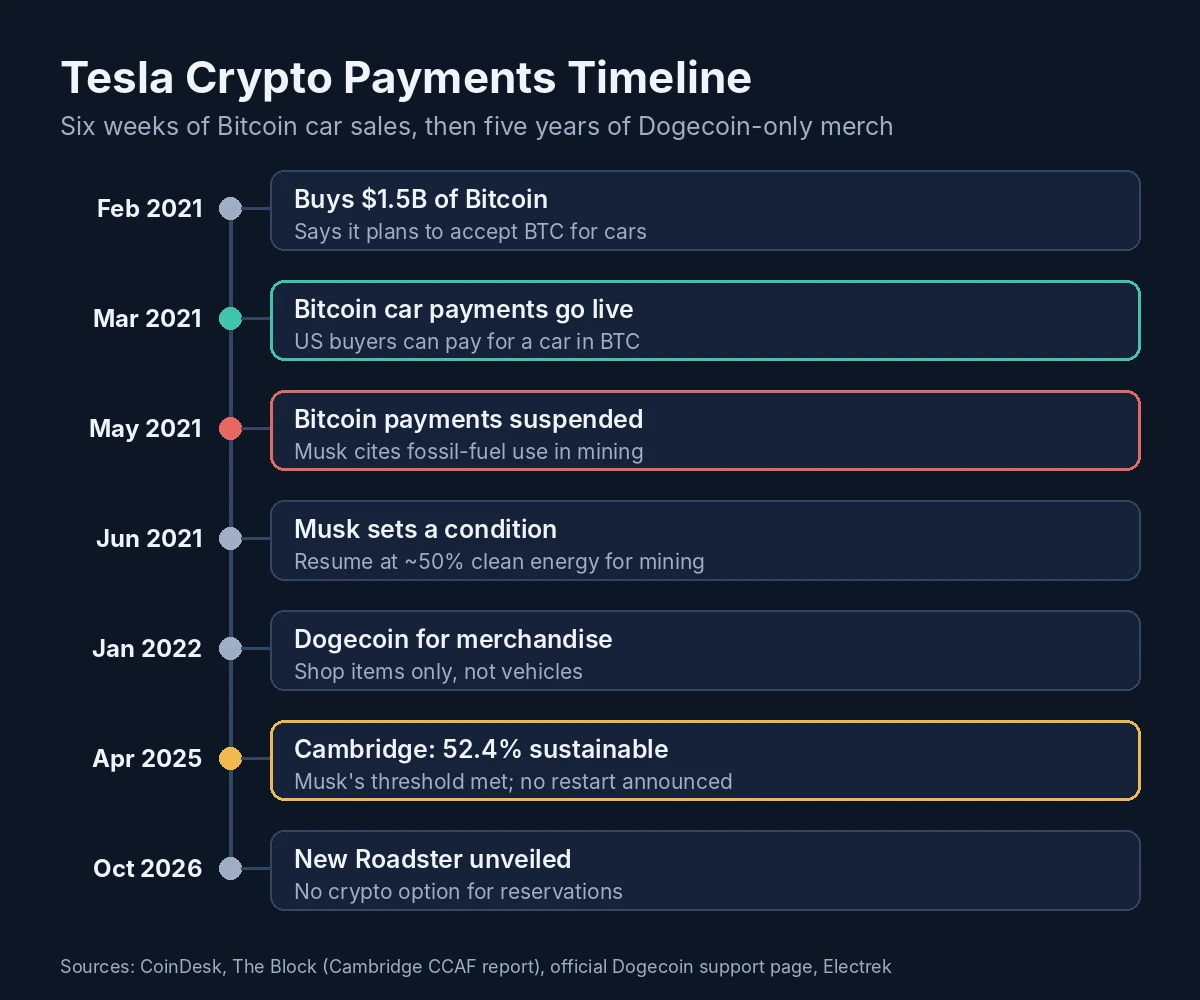
In June 2021, Musk set a clear condition. The company would resume Bitcoin transactions once there was “reasonable (~50%) clean energy usage by miners with positive future trend.”
In April 2025, the Cambridge Centre for Alternative Finance put Bitcoin mining’s sustainable energy share at 52.4%: 42.6% renewables and 9.8% nuclear. That was up from 37.6% in 2022 (The Block).
By Musk’s own yardstick, the door to Tesla crypto payments in Bitcoin has been open for 18 months. No restart has been announced.
The company hasn’t explained why Tesla crypto payments in Bitcoin never returned. The likely reasons are practical rather than environmental, and they apply to any carmaker weighing crypto.
Bitcoin fell from about $83,000 to roughly $58,000 in Q2 2026, then rose 42.7% in Q3 (edgeX).
Run a $50,000 Roadster deposit through those moves. Coins worth $50,000 on April 1 were worth about $34,940 by June 30, then about $49,860 by September 30.
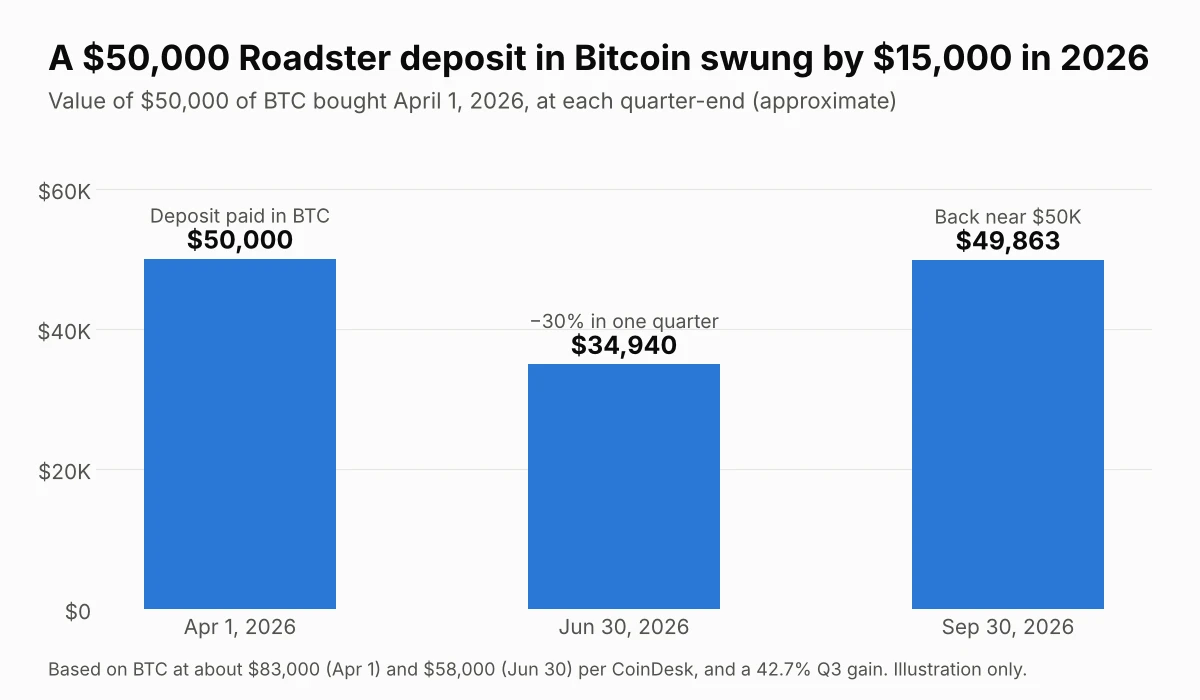
Whoever holds the coins carries that risk. If the carmaker kept them, a $15,000 swing per deposit would show up in its earnings, as its own 11,509 BTC already do.
In the US, spending crypto counts as selling it. Paying a deposit in Bitcoin can create a capital gain or loss.
Reporting is also tighter now. Brokers file Form 1099-DA for digital asset sales from 2025, and payment processors must report a customer’s payment sales once they pass $600 a year (IRS).
A $50,000 deposit paid in crypto would almost certainly be reported to the tax authorities.
The online shop’s systems are built to accept one coin. Expanding Tesla crypto payments to cars would mean a new payment rail, new accounting and new compliance checks.
Musk floated Dogecoin for cars in March 2024, saying it was something “we should enable” at some point (The Block). Nothing has followed.
The GENIUS Act, signed on July 18, 2025, created the first federal framework for payment stablecoins. Regulators missed the July 18, 2026 deadline for final rules (Crowdfund Insider).
The law takes effect by January 18, 2027 at the latest, or 120 days after final rules if those come sooner. Large merchants often wait for that certainty before switching on new payment methods, which matters for any future Tesla crypto payments in stablecoins.
Ferrari shows how a carmaker can accept crypto without holding any. Since October 2023, its US dealers have accepted Bitcoin, ether and USDC through the processor BitPay (Blockworks).
BitPay converts each payment to cash instantly, so neither Ferrari nor its dealers carry price risk. There’s no surcharge, and the car price stays the same.
Ferrari extended the scheme to European dealers in July 2024, citing requests from clients who had invested in crypto (The Block).
Mainstream checkout is moving the same way, which is a useful template for Tesla crypto payments. In June 2025, Shopify, Coinbase and Stripe began letting shoppers pay in USDC on the Base network, while merchants receive local currency by default (The Block).
If Tesla crypto payments for cars return, they will probably look like Ferrari’s model, not 2021’s.
A processor would take Bitcoin or a dollar stablecoin from the buyer and hand the carmaker dollars. The company would never hold the coins, so volatility would stay with the buyer until the moment of payment.
Stablecoins fit high-value purchases better than Bitcoin. Their price stays near $1, so a $50,000 deposit stays $50,000 during the 10-day window between the first and second payments.
Once US stablecoin rules are final, that route gets easier to justify. Even then, it would be a business decision, and Musk has said the Roadster may not “move the needle massively” on revenue.
This mirrors how companies approach Bitcoin more broadly. Our guide to institutional crypto adoption explains why treasuries and payment teams treat crypto so differently.
No. Bitcoin car payments were suspended in May 2021, and no crypto option exists for Roadster reservations.
Only Dogecoin, and only for eligible items in its online shop.
Musk cited fossil-fuel use in Bitcoin mining. He said payments would resume at about 50% clean energy, a level Cambridge researchers reported in 2025.
Ferrari accepts Bitcoin, ether and USDC through BitPay at US and European dealers, converting each payment to cash instantly.
Not in the US. Spending a stablecoin is still a disposal, though gains are usually tiny because the price stays near $1.
This article is for information only and is not financial, tax or investment advice. Crypto prices are volatile and you can lose money.
A weekly briefing on Bitcoin price action, Ethereum, crypto market analysis, Bitcoin ETF flows, regulation, digital assets, and the narratives shaping crypto investing.
One sharp weekly read. No daily alerts. No recycled headlines.