THE CHAIN JOURNAL
Independent Crypto Editorial

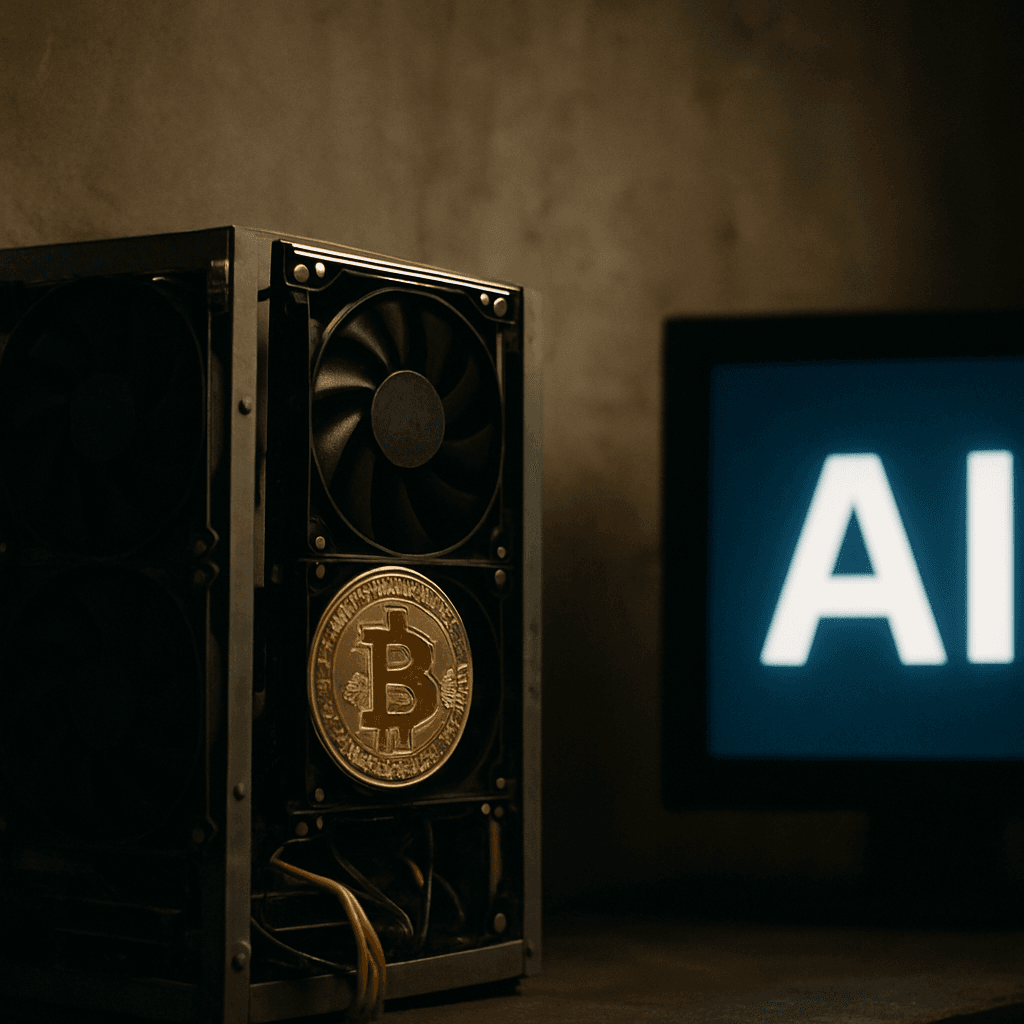
bitcoin miner ai pivot: Ionic Digital eyes a Nasdaq direct listing as bitcoin mining stocks chase high-performance computing revenue.
Ionic Digital’s bitcoin miner ai pivot is less a novelty than a test case. A Celsius-linked miner that once depended entirely on block rewards is now pitching public investors on infrastructure optionality rather than coin production. The company’s plan for a Nasdaq direct listing arrives as markets keep rewarding operators that can credibly attach themselves to high-performance computing demand – and that shift carries real weight. The old mining model has become increasingly difficult to defend on its own, particularly for firms still carrying legacy balance-sheet scars from the last cycle. This isn’t simply a story about miners wanting to become AI landlords. It’s about which of them can make that transition without destroying equity value in the process.
The broader backdrop is already visible across the sector. Public bitcoin mining stocks have increasingly traded like hybrid energy-and-compute plays rather than pure proxies for Bitcoin’s price. That re-rating has given management teams a window to refinance, rebrand, and in some cases sell down treasury holdings to fund data-center upgrades. Ionic Digital’s bitcoin miner ai pivot therefore arrives at an awkward but logical moment: investors want exposure to AI infrastructure, yet they’re also learning that power contracts, site quality, and financing discipline matter far more than narrative. In that sense, the listing isn’t the headline – it’s the proof point.
The immediate question is whether Ionic Digital can persuade the market that its assets are worth more than the sum of their mining rigs. In practice, a bitcoin miner ai pivot only works if a company can demonstrate that its electricity access, cooling systems, and site footprint can support recurring workloads beyond hash production. That’s why peers converting facilities toward AI and high-performance computing have become such a useful reference point. The trade is straightforward – lower exposure to Bitcoin volatility in exchange for more predictable, enterprise-style demand – but predictability comes with execution risk, and the market has shown little patience for sloppy transitions.
Recent sector moves suggest investors are willing to pay for credible transition plans, not vague promises. Some miners have raised fresh capital, others have monetized portions of their Bitcoin inventories, and several have leaned on the same core argument: a balance sheet built for cyclical mining can be redeployed into digital infrastructure if management moves early enough. Ionic Digital’s bitcoin miner ai pivot will be measured against that standard, not against its own branding. A public-market pitch that lacks hard metrics on power capacity, contract quality, and conversion timing risks looking more like an exit ramp than a growth story. For context, price action across the group is still tracked through crypto market prices, but equity investors are clearly looking past spot Bitcoin and toward the underlying infrastructure economics.
The more interesting possibility is that Ionic Digital becomes another data point in a sector-wide rerating. A bitcoin miner ai pivot changes how analysts value the business entirely: the question shifts from how many coins a miner can produce to how efficiently it can monetize stranded power. That’s a more sophisticated framework, but also a harsher one. It forces management teams to defend capex, lease terms, utilization rates, and customer concentration. The old mining story offered simple leverage to Bitcoin. The new story is operational leverage to electricity and compute demand – a meaningfully different skill set. Not every miner with a warehouse and a transformer will earn an AI multiple.
That distinction is why the market has begun separating genuine winners from hopeful pretenders. Companies with real grid access, large-scale footprints, and financing capacity can still attract capital. Others may find that their Nasdaq direct listing becomes a discovery mechanism for how little the market values undifferentiated assets. The relevant comparison isn’t crypto hype versus AI hype; it’s scarce infrastructure versus commoditized hash power. Ionic Digital’s move also sits within the broader debate over institutional ownership of Bitcoin exposure – a theme closely tied to strong ETF inflows, where capital has increasingly gravitated toward cleaner, more liquid vehicles.
For investors, the bitcoin miner ai pivot is only useful when it produces measurable economics – not better presentation slides. Ionic Digital’s plan will matter if it can demonstrate that its power, location, and financing stack support a durable business beyond the next Bitcoin cycle. A Nasdaq direct listing may improve price discovery, but it won’t rescue weak assets or shore up a vague strategy. In the current environment, the premium belongs to operators that can prove conversion discipline, not those who simply describe optionality.
The indicators worth watching are straightforward: site conversion timelines, customer announcements, capital structure clarity, and whether management commits to explicit high-performance computing revenue targets. If those elements remain undefined, the market is likely to treat the listing as a financing event rather than a re-rating catalyst. The bitcoin miner ai pivot will either produce a cleaner valuation framework – or expose just how narrow the moat really is.
Focus: The bitcoin miner ai pivot is becoming a valuation test, not a slogan.
Aryanna Vaz, Portfolio Strategy Analyst, The Chain Journal
A weekly briefing on Bitcoin price action, Ethereum, crypto market analysis, Bitcoin ETF flows, regulation, digital assets, and the narratives shaping crypto investing.
One sharp weekly read. No daily alerts. No recycled headlines.




