THE CHAIN JOURNAL
Independent Crypto Editorial

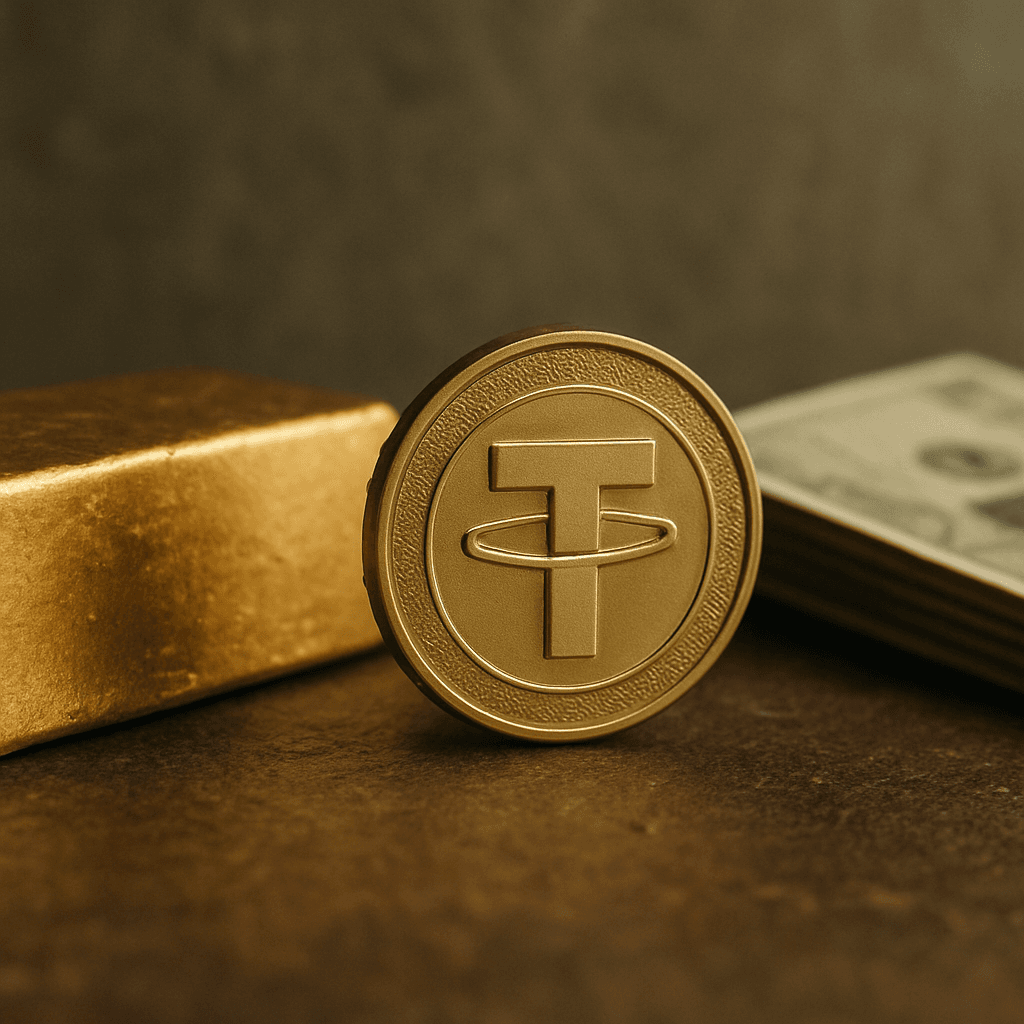
tether stablecoin news on aUSDT’s wind-down, gold-backed stablecoin strategy, and what it means for stablecoin liquidity.
The tether stablecoin news around aUSDT is best read as a portfolio decision, not a panic move. Tether is trimming a product that never became core to its liquidity stack, reallocating attention toward assets and rails that already show deeper demand. That distinction matters. In stablecoins, breadth is useful – but depth wins. Tokens that earn repeated use, move across venues smoothly, and retain network effects tend to dominate. Tether stablecoin news now fits a familiar pattern for the issuer: concentrate on products where liquidity, distribution, and brand trust reinforce each other, rather than keep niche experiments alive for symbolic reasons.
The broader market also gives this move context. Tether stablecoin news arrives while the company continues pushing its flagship dollar token and expanding adjacent products tied to tokenized gold and payments. That suggests a cleaner internal hierarchy: the reserve-backed dollar asset remains the core, while gold-linked exposure sits closer to a thematic hedge. aUSDT appears to have lacked the scale to justify ongoing maintenance, especially when users already have multiple paths into Tether’s ecosystem, including the Tether stablecoin itself. The signal here is not that Tether is retreating from experimentation – it is that experimentation now has a hurdle rate.
Tether stablecoin news is increasingly a story about product discipline. Over the past year, the company has pushed hard on the economics of utility: tokens need clear demand, meaningful circulation, and enough turnover to justify integration. That logic is visible across the wider market. Tokenized gold has drawn serious attention because it sits at the intersection of macro hedging and on-chain portability, while dollar stablecoins continue to dominate everyday settlement. Against that backdrop, aUSDT looks like a comparatively narrow bet. Tether stablecoin news should therefore be read as a signal that the issuer prefers to concentrate on instruments with broader reuse, stronger venue support, and lower operational drag.
The on-chain implication is straightforward. Every additional asset adds fragmentation: more pools to seed, more integrations to maintain, more liquidity to defend. Tether stablecoin news around aUSDT implies a preference for tighter capital efficiency – and that makes sense at a moment when stablecoin liquidity is judged not just by headline supply, but by how cleanly tokens clear across exchanges, wallets, and payment routes. The company’s recent emphasis on deeper reserve credibility and more durable product lines suggests that smaller, derivative-style offerings now face a stricter internal test than they once did.
Tether stablecoin news makes more sense when viewed alongside the company’s growing gold posture. Throughout 2026, Tether has leaned harder into tokenized gold, reflecting the market’s renewed appetite for hard-asset exposure and a broader preference for collateral that feels less vulnerable to fiat policy risk. That does not mean gold is displacing the dollar token – far from it. What it does mean is that Tether is building a clearer product ladder: cash-like settlement at one end, hard-asset optionality at the other. aUSDT, by contrast, occupied a thinner middle zone that may no longer justify the attention it requires.
That shift also fits the structural direction of the sector more broadly. Stablecoin issuers are being rewarded for simplicity, transparency, and distribution – not product sprawl. Tether stablecoin news therefore reads as both a balance-sheet and a brand choice. If a product does not deepen the moat around liquidity and use cases, it becomes a candidate for retirement. The same logic has shaped product transitions across the ecosystem, where issuers increasingly optimize for a few high-conviction lines rather than maintaining many marginal ones. In practice, that kind of consolidation usually sharpens execution and reduces confusion for everyday users. For a deeper look at how stablecoin regulation in 2026 is reshaping issuer priorities, the pressure toward simplification becomes even clearer.
Tether stablecoin news should not be overread as a systemic risk event. aUSDT was never at the center of stablecoin activity, so its wind-down is more likely to register at the edges than in the core market. Still, the move says something important about where the industry is heading: issuers are narrowing product sets and forcing capital toward the deepest pools. That tends to strengthen winners and expose weakly used variants. For liquidity providers, the implication is cleaner inventory management; for users, it is a reminder that not every branded token has staying power.
The broader market backdrop remains favorable for dominant assets. Stablecoin usage continues to climb, and Tether remains the reference point for dollar liquidity across much of crypto. Share data and rankings shift over time, but the underlying pattern holds: large, trusted, frequently used tokens command the most relevance. As tracked by Tether stablecoin market data, scale and turnover consistently outperform novelty. That makes aUSDT’s retirement less surprising than it might appear at first glance – it is the kind of decision that tends to follow market consensus, not precede it. Those tracking crypto liquidity conditions will recognize the pattern: when capital concentrates, peripheral products rarely survive on goodwill alone.
Tether stablecoin news suggests the company is tightening its product stack around assets that actually move liquidity, not side projects that consume management attention. For investors, that typically reads as a positive sign of operational discipline. When a stablecoin issuer cuts a marginal line, it often signals that the core business is healthy enough to prioritize efficiency over breadth. In this case, the more important story is not aUSDT itself – it is the direction of capital and strategic focus behind the decision.
Investors should watch whether tether stablecoin news is followed by deeper concentration in dollar settlement, more tokenized gold integration, or further simplification of the product suite. The key signal will be whether liquidity migrates cleanly into the main products without friction, discounting, or user confusion. A smooth transition would confirm the wind-down is orderly. Persistent fragmentation, on the other hand, would suggest the ecosystem still depends on too many overlapping tokens to shed them without consequence.
Focus: tether stablecoin news is a sign of pruning, not weakness.
Adam McCauley, Senior Blockchain Analyst, The Chain Journal
A weekly briefing on Bitcoin price action, Ethereum, crypto market analysis, Bitcoin ETF flows, regulation, digital assets, and the narratives shaping crypto investing.
One sharp weekly read. No daily alerts. No recycled headlines.




