THE CHAIN JOURNAL
Independent Crypto Editorial

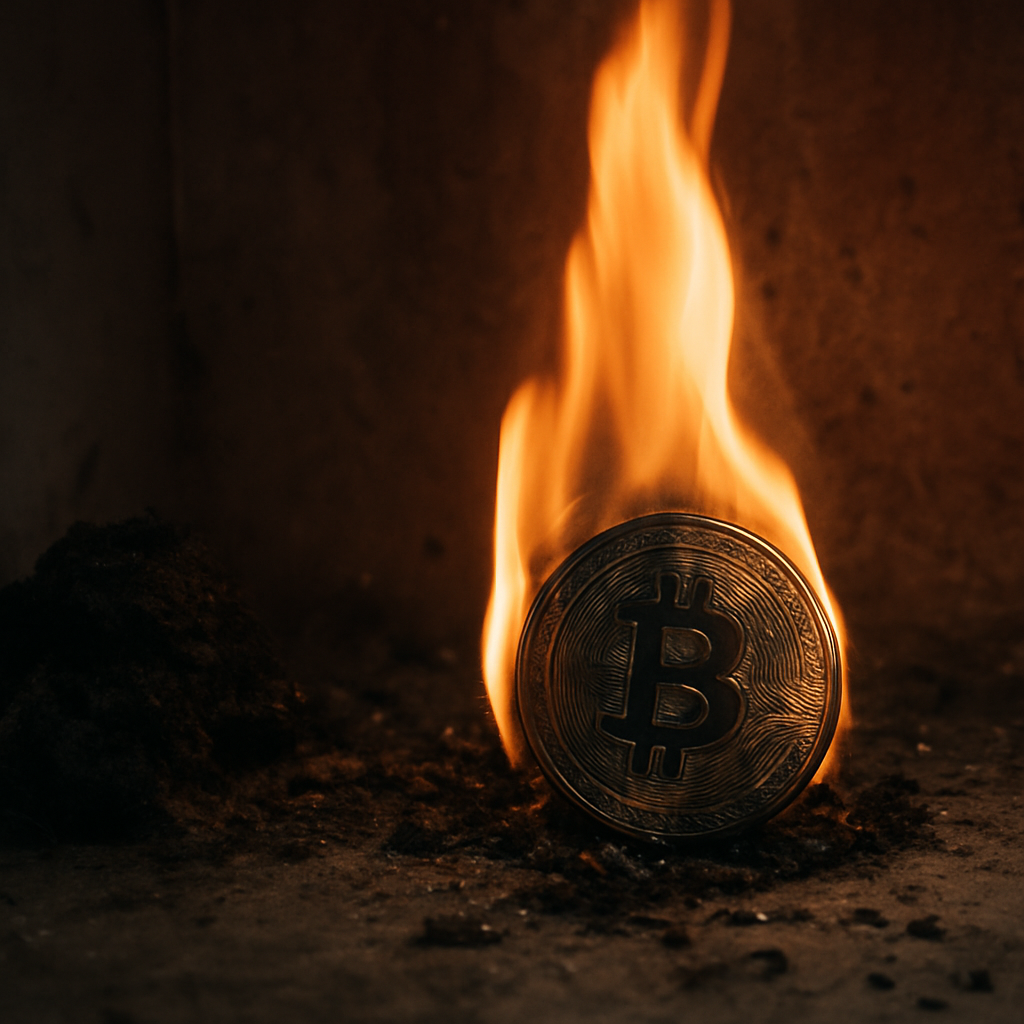
bitcoin burn removes 107 BTC as mystery bitcoin burn revives debate over unspendable bitcoin and bitcoin lost coins.
The latest bitcoin burn didn’t move markets on price alone – but it sharpened a familiar debate: how much of Bitcoin’s supply is truly available? An unknown entity sent 107 BTC to a known dead address, turning roughly $8.5 million into unspendable bitcoin after more than a decade of inactivity. At current prices, that stash is worth far more than when it first entered cold storage, which makes the move economically strange and psychologically revealing. The event sits at the intersection of error, intent, and long-term conviction, and each possibility tells a different story about the market’s hidden float.
For analysts, the bitcoin burn matters less as a headline than as a data point. Bitcoin’s supply may be capped, but its economic supply is not fixed in the same way. Coins can vanish from active circulation through key loss, address mistakes, or deliberate destruction – which is precisely why the market keeps returning to discussions of bitcoin lost coins and dormant wallets. This is not trivia. When older coins move, they can shift sentiment, reshape liquidity expectations, and alter how traders think about available supply.
The immediate mechanics are straightforward. A transfer to a provably unspendable address makes those coins functionally dead, even though the network continues to record them. In this case, the transaction involved 107 BTC spread across multiple transfers – a detail that makes the mystery bitcoin burn look less like an accidental click and more like a coordinated action. That distinction matters. A large, deliberate burn can signal a private decision about provenance, accounting, or messaging, while a simple error typically points to operational carelessness.
What matters more, though, is what the event reveals about Bitcoin’s supply structure. On-chain research has long shown that a significant share of BTC sits dormant for extended periods, and some of that supply may never move again. As tracked by Bitcoin on-chain analytics, long-dormant coins tend to behave more like stranded capital than liquid inventory. Viewed through that lens, a bitcoin burn is not an isolated curiosity – it is one thread in a broader pattern where old supply becomes economically inert, whether by design or by misfortune.
The market tends to romanticize lost coins, but the more useful framing is structural. A bitcoin burn reduces the accessible float, even if only marginally, and that can matter at the edges of a market where every new source of supply competes with ETF demand, treasury accumulation, and deep-seated holding behavior. Part of why this story keeps resurfacing is that Bitcoin’s transparency makes supply shocks unusually visible. Legacy wallets, burn addresses, and dormant clusters all sit in plain sight on-chain – even when the motives behind them remain opaque. For a deeper look at how liquidity conditions interact with these supply dynamics, the picture becomes more nuanced still.
There is also a second-order effect worth considering. If a bitcoin burn appears intentional, traders begin asking whether the sender wanted to prove control, erase traceable holdings, or simply remove coins from circulation for reasons nobody can verify. If it was accidental, the episode becomes a sobering reminder that custody friction still matters – even in an asset that markets itself as digitally sovereign. That tension is why this event deserves more attention than its dollar value alone would suggest. It touches both market microstructure and the very human error embedded in self-custody.
The bitcoin burn itself is not a macro thesis, but it reinforces a larger one: Bitcoin’s available supply is always smaller than the headline figure implies. When older coins disappear from active use, the market loses a sliver of liquidity, and that can quietly support price during periods of steady demand. The danger for investors is not the burn size – it is the temptation to overread it. A single event does not reshape Bitcoin’s core economics, but it does serve as a sharp reminder that supply can vanish without warning.
Three signals are worth watching going forward: whether additional dormant wallets begin to move, whether the transaction cluster gets linked to a known legacy holder, and whether this bitcoin burn coincides with broader spikes in older-coin activity. If the episode stays isolated, it will settle quietly into the category of supply oddities. If it proves part of a larger pattern, it may tell us something more meaningful about long-term holder behavior – and the steadily shrinking pool of BTC that is ever truly liquid.
Focus: The real story in this bitcoin burn is not destruction, but how little of Bitcoin is ever truly free to trade.
Adam McCauley, Senior Blockchain Analyst, The Chain Journal
A weekly briefing on Bitcoin price action, Ethereum, crypto market analysis, Bitcoin ETF flows, regulation, digital assets, and the narratives shaping crypto investing.
One sharp weekly read. No daily alerts. No recycled headlines.




