THE CHAIN JOURNAL
Independent Crypto Editorial


How Federal Reserve interest rate decisions move Bitcoin and crypto markets. What to watch before and after every FOMC meeting.
The fed rate decision crypto impact is one of the most direct and consequential relationships in modern financial markets. The Federal Reserve‘s monetary policy decisions do not just govern interest rates for banks and mortgages – they shape the global liquidity environment that determines how much capital flows into risk assets, including Bitcoin and the broader crypto market.
The mechanism is straightforward. Interest rates set by the Fed affect the cost of borrowing, the attractiveness of holding cash or bonds versus risk assets, and the strength of the US dollar. Each of these factors directly influences investor appetite for Bitcoin. When rates are low and liquidity is abundant, capital seeks yield and Bitcoin benefits. When rates rise and financial conditions tighten, capital retreats to safer ground and Bitcoin typically suffers.
What makes the fed rate decision crypto impact particularly significant in 2026 is the maturation of institutional participation. In earlier cycles, retail speculation dominated crypto price action, making the Fed connection looser and less predictable. Today, with billions of dollars in Bitcoin held through regulated ETFs and institutional portfolios, the correlation between Fed policy and Bitcoin price has tightened considerably. When the FOMC speaks, crypto markets listen – and react.
Understanding this dynamic is foundational to any serious bitcoin macro analysis. Investors who ignore the Fed are essentially navigating crypto markets without one of the most important instruments on the dashboard.
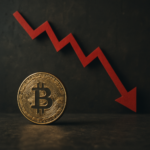
Rate hikes represent the clearest and most immediate expression of fed rate decision crypto impact on the downside. When the Fed raises its benchmark rate, the ripple effects move through financial markets in a predictable sequence. Borrowing costs rise. Liquidity tightens. The US dollar typically strengthens. And capital that was previously flowing into risk assets begins to rotate back toward bonds, money market funds, and other yield-bearing instruments.
For Bitcoin, this creates a double pressure. First, the opportunity cost of holding a non-yielding asset increases – why hold Bitcoin when short-term Treasuries are offering meaningful returns? Second, a strengthening dollar exerts direct downward pressure on Bitcoin prices, given the well-documented inverse relationship between the DXY and Bitcoin.
The 2022 Fed hiking cycle provided a stark real-world illustration. As the Fed raised rates aggressively to combat inflation, Bitcoin fell from above $60,000 to under $16,000. This was not purely a crypto-specific event – it was a liquidity-driven selloff across all risk assets, with Bitcoin among the most affected due to its high-beta characteristics.
Rate hikes also tend to dampen market sentiment broadly. When borrowing becomes more expensive and the economic outlook becomes more uncertain, retail and institutional investors alike reduce exposure to speculative positions. The fed rate decision crypto impact in a tightening cycle is therefore not just mechanical – it also operates through psychology and positioning.
The inverse of the above is equally important. Rate cuts represent the most favorable expression of fed rate decision crypto impact for Bitcoin. When the Fed lowers rates, the opportunity cost of holding non-yielding assets falls, liquidity conditions ease, and risk appetite improves across markets. Capital begins searching for higher returns – and Bitcoin is often among the primary beneficiaries.
Lower rates also tend to weaken the US dollar over time, which historically supports Bitcoin and other crypto assets – including Ethereum, whose price is equally sensitive to the Fed’s liquidity cycle. This dynamic connects the Fed’s policy cycle directly to the broader CPI inflation and Bitcoin narrative – both are expressions of the same underlying monetary environment.
The 2020 rate cuts to near zero, combined with unprecedented quantitative easing, produced one of the most significant Bitcoin bull markets in history. The fed rate decision crypto impact in that episode was amplified by fiscal stimulus, institutional entry, and a broader reassessment of monetary risk – all of which converged to drive Bitcoin from under $5,000 to above $60,000 within eighteen months.
It is important to note, however, that rate cuts are not automatically bullish for Bitcoin in isolation. The macro context matters. Cuts driven by economic emergency – a recession, financial crisis, or systemic shock – can initially be negative for Bitcoin if they trigger a broad risk-off response before the liquidity benefits materialize. Timing and context shape the fed rate decision crypto impact as much as the decision itself.
Investors looking to anticipate the fed rate decision crypto impact ahead of each FOMC meeting should monitor a specific set of macro indicators that signal the direction of Fed thinking.
“Understanding the intertwining of traditional finance and cryptocurrencies is pivotal in navigating today’s complex market environment. The fed rate decision crypto impact is not a peripheral concern – it is central to how Bitcoin trades.”
A review of past FOMC cycles reveals consistent patterns in the fed rate decision crypto impact. The 2018 hiking cycle coincided with Bitcoin’s collapse from nearly $20,000 to under $3,500. The emergency cuts of March 2020 preceded one of the strongest Bitcoin rallies ever recorded. The 2022 aggressive tightening campaign drove Bitcoin from cycle highs above $68,000 to lows below $16,000 – a drawdown that closely mirrored the behavior of other high-risk assets under identical macro pressure.
These historical episodes confirm that the fed rate decision crypto impact is real, persistent, and increasingly predictable in its directional effect – even if the magnitude varies based on crypto-specific factors like ETF flows, supply dynamics, and on-chain positioning. Understanding how macro news events translate into price action around FOMC dates is one of the most practical skills for active crypto investors.
As of 2026, the Federal Reserve is navigating a delicate balance between residual inflationary pressure and slowing economic growth. Rates were held at 3.75% following the most recent FOMC meeting, with four dissenting votes – a signal that the committee is divided and that future decisions will be highly data-dependent.
The current environment creates a nuanced fed rate decision crypto impact. Elevated rates are keeping financial conditions tighter than Bitcoin bulls would prefer, but the expectation of eventual cuts – driven by softening economic data – is providing a floor under institutional demand. Bitcoin ETF flows remain the clearest real-time indicator of how institutional investors are interpreting the Fed’s signal through their positioning.
Looking ahead, any pivot toward rate cuts – even a single reduction combined with dovish guidance – is likely to be a significant positive catalyst for Bitcoin. The fed rate decision crypto impact in a cutting cycle, combined with tight post-halving supply and sustained ETF demand, could create the conditions for a decisive upside move. Investors should monitor each FOMC meeting with the same attention they would give to any major market-moving event – because in 2026, that is exactly what it is.
TCJ Editorial for The Chain Journal
A weekly briefing on Bitcoin price action, Ethereum, crypto market analysis, Bitcoin ETF flows, regulation, digital assets, and the narratives shaping crypto investing.
One sharp weekly read. No daily alerts. No recycled headlines.